Jun 12, 2020

Dispatch from Coronaville: Narrowing the Focus

Once again I recorded my numbers last night, but was too exhausted to complete the blog. Now as I go back to finish up this post the reality on the ground has changed in the last 24 hours.


Good times in Florida gone, last summer in the Time Before

As we continue to weigh possible plans for the summer, I've started narrowing my focus to the county level. It's useful to know how the specific place where I live and the place I might like to visit are doing in regards to the virus.  The highlight of each summer for our family is our visit to Florida to spend time with my mom and siblings. My boys love playing their cousins and they look forward to this trip all year.

 The only way we'll be able to do it is if cases have been consistently decreasing for awhileA comment on my last Dispatch awakened me to the idea of looking at the counties instead of state as a whole. After all if the major outbreaks are in one corner of the state while the numbers in your neighborhood have been declining for weeks, then maybe a visit isn't out of the question.

The good news was that Lake County in Florida, where my mom and sister live has only seen 342 cases of the virus and 15 deaths.  They did not add any new cases or deaths  yesterday.  However, I checked again today and Lake County appears to have joined the Florida Surge, with 41 new cases added today, bringing the county total to 383.

The bad news is that Franklin County where we live has the highest rate of infections and deaths in the state of Ohio.  We added 74 new cases since yesterday, and another 177 new cases added today. 

So for now, the annual trip is on hold.

As of yesterday, the total number of cases in the United States now exceeds 2 million, as I predicted.  Still, I was about 7000 over the actual number, 2,033,467 total cases, a 3.2% increase. On the other hand the total deaths were higher than I predicted by about 1300: 113,961 total deaths, a 3% increase. Based on these numbers I would expect 2,098,538 total cases by Sunday, June 14 and 117,380 total deaths. With about 25,000 new cases added in the 24 hours since I made this prediction I have a feeling my projection is too low.


Florida launched off the chart again with 4165 new cases over the previous three days. (I checked today and the state has since added almost 2000 more cases in the last 24 hours). Ohio showed a slight uptick (with another 420 cases added today) and Nebraska stayed flat with another 378 new cases.
Total Cases as of yesterday:
Florida: 69,061 total cases, 0.32% of the population
Ohio: 40,004 total cases, 0.34% of the population
Nebraska: 16,130 total cases, 0.83% of the population


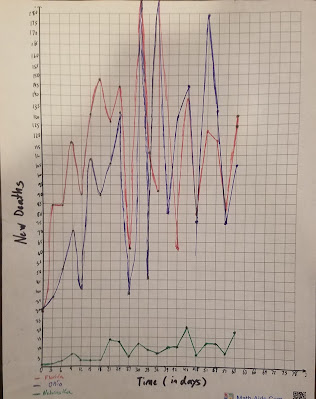
New deaths in all three states are up over the previous three days.with Nebraska documenting it's third highest three-day total of new deaths since I began tracking the data in that state.
Total Deaths as of yesterday
Florida: 2,847 total deaths, a rate of 4.1%
Ohio: 2,490 total deaths, a rate of 6.2%
Nebraska: 211 total deaths,  a rate of 1.3%

Jun 9, 2020

Dispatch from Coronaville: The Next Two Weeks


The next two weeks will be very telling, I believe. One of three things could happen:  

We could see a sharp increase in the number of new COVID-19 cases, and another few weeks after  that,a sharp increase in deaths, as protesters and police succumb.  

We could see our current numbers maintaining more or less, but not dropping. This might indicate that the protests did enough to halt the decline but not enough to cause a significant increase.

We could see the overall national decline continue--some hotspots notwithstanding--indicating that the worst of the virus is over for now.

These numbers are actually from yesterday.  I gathered the data but was too tired to do the post.

As of yesterday, there were a total of 1,969,786 total cases of COVID-19 (a quick check of the most recent data indicates we've added 20,000 to that number today). This represents an increase of 3.6% over the previous three days and about 14,000 less than I predicted. As for deaths, as of yesterday there had been a total of 110,951 deaths in the U.S. from COVID-19 (we've added 1200 more today).  The good news is that this represents  a 1.5% increase over the previous three days and 2,500 fewer than I predicted.  This is the lowest percent increase in deaths we've recorded so far.  With these percentages in mind, I'd predict that by Thursday, June 11, we'll surpass the two million mark with 2,040,699 total cases and 112,615 total deaths. 

New Cases

Florida continues to surge. New cases dropped but only to the third highest number since April 3 (and the state has added another thousand cases today). Meanwhile Ohio and Nebraska continue what looks like an honest-to-goodness downward trajectory. 
Here's the data on total cases:
Florida: 64,896 total cases, 0.3% of the population
Ohio: 38,837 total cases, 0.33% of the population
Nebraska: 15,752, 0.8% of the population


New Deaths

If there's any patterns to the deaths from this disease, it's that of macabre heart rhythm, up and down, up and down. I'm glad to report that all three states are posting some of the lowest numbers of new deaths they've had (Florida, second lowest number of deaths, Ohio fourth lowest, and Nebraska third lowest). However I should note that Florida has already posted as many deaths today as it did in the previous three days which means that Thursday's numbers may not look so good for the Sunshine State.  Meanwhile today Ohio added only 17 deaths. and Nebraska added three, also as many deaths as they had in the previous state, but Nebraska has been known to go a day or two without any deaths, so we'll see.
Total Deaths:
Florida: 2,711, a rate of 4.2%
Ohio: 2,404, a rate of 6.2%
Nebraska: 196, a rate of 1.2%

Jun 7, 2020

Angry: Do's and Don'ts for Critiquing the Riots


A peaceful protester in Atlanta, Saturday, June 6, 2020. Property is important for sure, but our priority should always be people first. (Photo credit to my old friend and colleague from our earliest Saipan days, Tenera Armbrister-Carey)

Are you appalled by the violence, the looting, the destruction of private property attending these protests in the wake of George Floyd's death?  Thinking about voicing your disgust among like-minded friends, random strangers, or sharing on social media?  Here's some helpful tips to help you decide if you should go ahead and fuss:

Do Fuss: If you are the owner of a business that is being directly impacted by rioting and looting. I have no issue with people locking and loading to protect what's theirs.  I mean, you don't have to, but it is certainly your right and I support that. I know I'd take action to protect my property and safety. 

Do Fuss: If you've been attending the protests yourself and have had to "get into it" with supposed protesters who are tearing up property, not listening to the instructions of the protest organizers and so on.

Do Fuss: If you are frustrated because the riot and looting is taking attention away from the legitimate concerns about systemic racism and police brutality in this country. 

Don't Fuss: If you've been shaking your head at the pics on your social media feed and inflammatory videos from your favorite websites, but haven't actually been there yourself. 

While it's noble to be concerned for those who are suffering in the neighborhoods where rioting and looting are taking place, don't fuss if you've never invested any time or treasure in these selfsame neighborhoods. 

Do acknowledge that the situation on the ground is more complex than a video clip or meme may indicate. There are some who are rioting out of pent-up frustration, the voices of the unheard, as Dr. King put it. There are plenty of others who are simply opportunists, selfish people taking advantage of situation to grab some free stuff.  There are people who just want to cause trouble--some on the "side" of the protesters, but also some who are deliberately trying to bring the protests into disrepute.  And then there are the way the police show up--expecting trouble, ready for it, and perhaps creating a self-fulfilling prophecy. I've yet to a hear of a police force that got overwhelmed by the rioters because they showed up without riot gear and teargas. 

If you really care about us, about black people, then do not allow yourself to be distracted. It goes without saying that riots and looting are wrong. What doesn't go without saying is justice and fixing a broken system.

Angry: The Problem with the Police


Stock Photo via Pond5

I have never had a bad encounter with the police.  When I've been pulled over my biggest fear has generally been about what's about to happen to my bank account. I've written about the police before on this blog, over ten years ago in a post entitled "Lessons Learned from the Long Arm of the Law." Spoiler alert: It was positive. Even after everything that has happened in the past few weeks, if I felt like I or my family was in danger, I would still feel comfortable calling the police.*  A police officer--an African American woman--lives in our neighborhood.  And this guy right here was one of my students' heroes--and is one of mine too.


Former student El-Ryck Kendrick with one CPD's finest. El-Ryck chose the Columbus Police Department as oneo f his heroes for my 7th and 8th graders Heroes Reception back in 2013 and this officer attended the gala event as the department's representative.

Now, don't get too excited. Before you run off sharing this post far and wide as proof that the police don't have a problem (See, this black guy says he's not afraid for his life!).  You might want to keep reading. You see what I am is anecdotal evidence (I just talked about this in a recent Dispatch from Coronaville post). One person's story is not proof of a general principle.  At issue here is not individual police officers personal prejudices or an individual black person's response.  The concern is a systemic need for accountability when it comes to what the police can do without consequence.

Here's the reality: The relationship between the police and predominantly black communities, the relationship between law enforcement and black people has been fraught for a very long time.  Again, understanding history is vital to understanding racism in America.  For generations the police have been white society's chief tool for keeping black people "in line."  While for most white Americans, the police are friendly presence that makes them feel safe, for most black Americans a police presence is cause for heightened caution. And that's true even for me. I generally don't worry about getting  mistreated by cops, but I also would never have the temerity to do this, like, ever: 


Getty Images

  We are not certain the police are on our side, and that is because for a long time they haven't been. I find that many white people have this kind of knee jerk defensiveness whenever there is even mild criticism of the police.  And it makes sense, after all, since the police have always been there to serve and protect their interests.  That has not been the case historically for black people.  I guess the idea is that the approach of policing black America instead of protecting them just kind of disappeared sometime after Martin Luther King Jr? How does that work exactly?  Has it worked?

Let me clear up a few misconceptions:

The problem isn't that police killings are the leading cause of  death among black Americans. They are not. A common misdirection is to point out that a black person has greater chance of being killed by a another black person than by a police officer.  But that's not the point. We are not arguing about who one is most likely to be killed by, but addressing why black Americans have a higher likelihood of being killed by police than their white peers do

The problem is not the racism of individual officers. It's not about a few bad apples and mostly good cops. It's not even about the racism of white people in general.  The undercover cop who killed Prince Jones, an unarmed black man, back in 2000 was black.  Some of the officers involved with the death of Freddie Gray were black. And at least one of the four cops arrested for George Floyd's death doesn't look quite white (and I"m not talking about the Asian officer).  Racist assumptions about black pathology, the supposed inherent violence of black people, the danger of "black anger", the risk of the physicality of the black man (side note: one of the reasons I worry less is because of my build; I can't conceive of myself looking like a threat to anyone, which is not quite the same as saying that I wouldn't be perceived as a threat)--all of these things affect everyone of every race. They permeate our society. It seems absurd to think that somehow law enforcement would be immune from these assumptions. 

The problem is police being allowed too much latitude to harm civilians as part of doing their job. I believe it was Floyd's status as a black man that led to Chauvin to put his knee on Floyd's neck (I have a hard time imagining Officer Chauvin would have done this to a white man or woman). But it was Chauvin's status as a police officer that led him to keep his knee on Floyd's neck, ending his life.  He believed that there would be no meaningful consequence for his actions. And he had good reason to believe so, given the litany of complaints against him over the years all of which had come to naught. He was certain that the thin blue line, that code that officers share, would rise to protect him.

There are service professions: Teaching, medicine, and firefighting are examples.  Police work is also intended to be a service profession.  Police exist--or should exist--primarily in a defensive capacity, to keep people safe.  They are not intended to be soldiers. While in rare cases they may have to use deadly force, their job is not to kill people. If you want to be a solider, join the military, not the police. 

The solution to our police problem is clear. It's not making officers "less racist."  You can't mandate a change of heart.  What we can do is enact laws that hold police accountable. No police officer should go about their work feeling that they can do pretty much whatever they want without consequence. It's fair to say most police officers won't take advantage of that opportunity, but there are those who will. And there are many who wouldn't themselves but who will feel duty bound to close ranks around their fellow members of the force who do. We've had this backward notion that because the police have greater power they should have less responsibility, less accountability.  Conviction of these four officers should be a given, but even if they are convicted (and especially if they are not) our focus needs to be on drafting laws that demand accountability from police for the actions they take.  For the "not about race" crowd,  and you libertarians concerned about the authoritarian state--this is your moment. These laws wouldn't be "about race", they would benefit everyone. But they would especially benefit those who have been dis-proportionally affected by police violence.

Calling for police reform is not anti-cop anymore than calling for education reform is anti-teacher. We can do better.  We must do better. And when we do everyone will benefit.


*And that's what I did. How's this for irony. Guess what I did just as I was beginning to work on this post last Thursday night?  I called. ..the police.  Barbara was working late at her school. No one else was in the building. She heard voices and saw at least four people walking around outside her classroom windows. She was afraid to go out into the darkened back parking lot alone. Since we have only one vehicle, I couldn't go to her which is what I would have done. She never told me the race of the people outside--she may not have known--and I never asked.  She asked me to call the police for her, and I did. It turned out that there a group of eight guys playing basketball in the gym across from Barbara's classroom with the lights out. It's not clear how they got in, but it appears a door was left unlocked. They were cooperative by all accounts, and left without incident.


Jun 5, 2020

Angry: This Woman Makes Me Happy


I want to go in a different direction today.  There's still a lot of unpacking to do.  So much that has to be taught and learned (and unlearned) as we try to end the evil of racism in our country. But for a moment I want to think about what a future would look like that is truly just, where black people are fully equal citizens. I was listening to the radio a few months ago and I heard it. And I have to tell you, it was the most wonderful thing. It was so exceptional that even now when I think about it, I just feel warm and fuzzy.

Ayesha RascoeThat's her name. She's a reporter for NPR .

So what made her report so remarkable? The fact that it was so unremarkable. It was polished, professional. She sounded like she really knew her field.  Okay, I know you're eyeing me skeptically now. What are your trying to say? This sounds suspiciously like "clean-cut and well-spoken."  That is not what this. I always feel some kind of way when my students are effusively praised for their stellar behavior on the 8th grade class trips over the years (and they are always praised for their stellar behavior). Like why do we need all this praise, is if black kids acting right is so out of the ordinary. So don't get it twisted. It's not that I'm surprised that a black woman can be polished, professional and really know her field. I could name multitudes who fit that bill. So what's the big deal then, you ask?  

It's this.  This was an identifiably black woman--with a distinctively black accent, not one of those white-sounding newscaster voices (no judgement here, by the way, since I happen to have exactly that white newscaster kind of voice) and a distinctively black name.  And best of all she wasn't reporting on "race issues" or "the culture" or "entertainment"--she was reporting on foreign policy.  Foreign policy, like just any other reporter, intelligently and concisely breaking down the details. I loved it. I was pleasantly surprised, not that she was capable, but that she was allowed to be capable, in a field that hadn't been "designated" for blacks, and still be black.

What does it mean to be fully a part of our society?  It means to be allowed to be ourselves--whatever that is--without being relegated to a certain corner or topic. It means that we don't have speak in a way that soothes white ears. It means the names we give our children don't have to be an impediment to being taken seriously. 

Tonight I found a selection of her reporting on NPRs website and listened to one segment, just to hear the sound of the future.

Dispatch from Coronaville: We are done with virus; Is the virus done with us?

Our church parking lot this afternoon at least half full of cars for a funeral held there today. Not many folks wearing masks. I have no judgement of these folks gathering together to say farewell to someone dear to them. I'm just making an observation.
We are moving on.  We are done with the coronavirus and looking to other things.  The job market added jobs this month. More and more things are opening up.  There's still the occasional nod to masks and social distancing here and there, but by and large we are concluding our business with COVID-19.

The question is: Is the virus done with us?  Is COVID going to let us walk out the door. Or will it grab us by the arm and yank us back into our chair, get uncomfortably in our faces, and say through gritted teeth: "I'm not done with you yet!:  I believe this month will tell the story.

Almost one month ago I did a little review of the previous month in Coronavirus and made predictions for the upcoming month.  Now here we are.  By the time I post this (It's 11: 50 PM right now) it will be June 6, exactly one month since the last time I took a step back for the bigger picture.  So it's time to do it again.

I'm pleased to report that the increase in cases and deaths were a lot lower than even my prediction based on half the rate of increase. I thought we'd have 2.4 million cases in the U.S. by now, but instead we are only at 1,911,444 total cases, an increase over the past month of 56%. Likewise with deaths I expected there would be 275,000 deaths in the U.S. but instead we only have 109,299 deaths,  an increase of 34% over the past month. I decided that for my predictions over the next month I would keep use the same percent increase instead of reducing it by half as I did last month.  I try to be conservative in my predictions and right now, with the aftermath of re-openings and the protests still to come, I think reducing by half would be a little ambitious now. So: By July 6, I expect 2,981,853 total cases of COVID-19 in the United States, and 146,461 deaths.

As for our three-day numbers, the U.S. total cases increased by 3.8%, 5,500 more cases than I predicted. Meanwhile I'm gonna say I was statistically accurate on deaths, with the 2.3% rate of increase I predicted and only 20 fewer deaths than I projected. We really seem to be holding steady at this point, with a more or less constant rate of increase every three days. Based on these numbers I project 1,984,079 total cases by Monday, June 8 and 111,813 deaths.


On to the states.  The news is not good for Florida. Cases there have skyrocketed over the past three days with 4,041 new cases added to their tally.  They are literally off the chart. Perhaps these are the open-up protesters from a few weeks back finally paying the piper?  Ohio and Nebraska both posted modest gains in their number of new cases, but one might be able to argue that Ohio at least is showing an overall decline in the number of new cases. Still we will have to wait until Monday to begin the countdown clock again. 
Total Cases:
Florida: 61,480 total cases, 0.28% of the population. Florida's total cases increased by 65% over the past month. Based on that rate, I would expect 101,442 total cases in Florida by July 6.
Ohio: 37,758 total cases, 0.32% of the population. Ohio's total cases increased by 75% in the last month. Based on that rate  of increase I would expect 66,077 total case in Ohio by July 6.
Nebraska: 15,379 total cases, 0.79% of the population. Nebraska's total cases increased by 136% which was less than I projected but still a much higher rate of increase than Ohio and Florida.  Based on  that rate of increase I would expect 36,294 cases in Nebraska by July 6, a number that  would represent more than 1.8% of the state's population.


Florida and Ohio both showed increases in the number of new deaths in this three-day period, with Ohio outstripping Florida in this category. Only Nebraska continued a downward trend in deaths.
Total Deaths: 
Florida: 2,659 total deaths, a rate of 4.3%. Florida's new deaths increased by 81%. Based on that trend I'd expect 4,813 deaths by July 6.
Ohio: 2,355 total deaths, a rate of 6.2%. Ohio's number of Corona dead did not exceed Florida's as I had predicted. Their rate of increase was 90% and based on that number I'd expect 4,475 deaths by July 6
Nebraska: 193 total deaths, a rate of 1.3% Nebraska total deaths increased by 133% over the past month. Based on that rate of increase I would expect 450 total deaths in Nebraska but July 6. 

Jun 2, 2020

Dispatch from Coronaville: Science


Today I'd like to talk a little bit about science.  Science has come under attack from a lot of quarters in recent years, the most recent attack coming from what I call the coronavirus deniers. I think at least some of this hostility stems from a fundamental misunderstanding of how science works, what it does and doesn't do.

First off, people tend to expect scientists to be right once and for all about what ever the scientific topic is at hand. But that's not how science works.  Science by its very nature is forever unfolding.  What appears to be definite can be overturned by the next discovery. Science abides by strict rules for determining fact and those rules mean that understanding must change with the evidence. To those of us on the outside it can seem wishy-washy.  First they said this was dangerous, now they are saying it's safe. First they said do this, now they say don't do this, do that instead. Do these guys even know what they are talking about? Man, I'm not listening to them. They don't know. . . Of course changing course based on changing evidence is not an invitation to ignore the guidance scientific findings can provide.  This article does a fantastic job of elaborating on the nature of science in the time of coronavirus and why people find it easy to dismiss scientific guidance.

Another thing we tend to do--that scientists do not do--is rely on anecdotal evidence. And it's understandable; what's more compelling than our own first hand experience? Thus we might say "Back in the day we didn't have all this PPE and we never got sick."  or "They're inflating the COVID numbers! My uncle died of a heart attack but the doctors put COVID-19 on the death certificate."  Those stories are compelling, yes. But. . .they're anecdotal evidence. And anecdotal evidence needs to be backed up by replication.  The same thing happening over and over again in trial after trial. Have randomized trials proven repeatedly that medical workers who toughen up their immune systems bv not using PPE get sick less than those who are fragile and protecty and keep their immune systems weak?  If so, that's scientific evidence. Are there thousands of documented cases by verified by multiple outside sources of doctors falsely attributing the cause of death to COVID-19. If not, you have your own experience not a conspiracy.  I know what we feel we've seen with our own eyes feels incontrovertibly true, but science inhabits a world where things are not always what seems obvious.

On the other end of the spectrum is the worship of anyone with some letters after their name.  Interestingly skepticism and reverence for the experts can often coexist--we trust the "experts" who confirm what we want to believe and dismiss those who don't. The doctors on YouTube said. . . Dr. Drew Pinsky says. . .blackballed scientist reveals shocking truth about the "plandemic." I think it's important to remember that all scientists, doctors, or medical professionals are not created equal.  Imagine you hear a high school calculus teacher waxing eloquent on YouTube about how reading should be taught to kindergartners.  Yes she's a teacher, but kindergarten and reading instruction is not her field.  Any knowledge she has on that subject will be minimal at best. If you get conflicting advice on helping your child with phonics you're better off listening to a kindergarten teacher--an expert in her field.  So it's not enough to tout experts and scientists and doctors. We need to ask what are the experts in this particular field saying? And then we should modify our own beliefs accordingly.  There will always be someone out there to confirm what we want to believe, but that's no way to get to the truth.

Finally, one thing that makes the COVID-19 pandemic more difficult, is that this virus really is new.  There is a lot even the experts don't know about it.  But here's the thing:  That doesn't put you and me on equal footing with the experts.  They don't know and I don't know, so my guess is good is theirs. No. No it's not. It's like a kindergartner looking at an Algebra problem, then seeing an 8th grader struggling with the same problem and saying, "Well shoot he doesn't get it either. I'm not listening to him when he comes to  help me with my addition worksheet and I am not believing him when he says he 'gets it now'. It's obvious 2x +3 = 12 is 5, because duh, everyone knows 2 + 3 is five. See! You just use a little common sense. Get's you a lot farther than that so-called expertise from those 8th graders who can't even figure it out themselves."

Even if the experts don't know, they know more than we do. And sure they may be wrong. Or we might be.  The question we have to ask is what's the price of being wrong?  Are we sure it's one we can afford to pay? What does the evidence seem to indicate?

Let's take a look:
The rate of increase in cases and deaths trended down a bit over the past three days. There have been a total of 1,841,407 cases, an increase of 3.5% since Saturday and 13,000 less than I predicted. Total deaths registered a 2.3% increase to 106,861, about 600 less than I predicted. Based on these trends I would expect 1,905,856 total cases by Friday, June 5 and 109,319 total deaths,


Looking to the states, new cases are once again down across the board, with Ohio recording it's lowest number of new cases in almost a month. The countdown clock starts again today with June 16 as the new goal date of two weeks of consecutive declines in the number of new cases.
Total Cases: 
Florida: 57,439 total cases, 0.26% of the population
Ohio: 36,350 total cases, 0.31% of the population
Nebraska: 14,611 total cases, 0.75% of the population


All states are showing fewer new deaths over the past three days, with Ohio again recording it's lowest number of new deaths since May 3.
Florida: 2,529 total deaths,  a rate of 4.4%
Ohio: 2,218 total deaths, a rate of 6.1%
Nebraska: 187 total deaths, a rate of 1.3%

Angry: The Fire

Themes in Racism: Fear of Black Anger

As part of this blog series, I will, from to time to time explore certain themes. Yesterday's post might fall under the theme of Things to Stop Saying. This one is under Themes in Racism. Here I will explore certain racist ideologies, presumptions, and prejudices that have become baked into our society over time, to the extent that most of the time we are unaware of their presence or their power. Today I want to focus on the fear of black rage.


Anger is like fire. Uncontained, it can be deadly, destroying everything in its path.  We have a whole organization whose primary duty is to put out fires roaring out of control. But fire is not, in and of itself, evil. Contained, channeled, and put to productive use it's useful, even necessary. So it is with anger.  We are discomfited by it, but it can be the right response and the necessary driver of change.

Which bring us to black anger. A fear of black anger and an obsession with controlling it have long been a feature of American society. Here's my armchair historian's take on why that is (real historians who have a better understanding are welcome to correct me; I'm not opposed to learning):

At first, the fear of black anger and the need to control it were born out of necessity. Slavery was, after all, the "necessary evil" and white people knew deep down that it was wrong.  They knew what they would want to do, what they would do, if they were in the slave's position.  The occasional violent slave revolt struck fear into the heart of every master.  After all in some places the slaves outnumbered the owners by a huge margin. Many of the restrictions on slaves--on education, on meeting together, on gun ownership-- as well as the brutal punishments meted out to slaves were meant to prevent them from unleashing the wrath that surely must be there, burning under the surface.

This is one reason there has been a long history of irritation with agitators on the part of white people. In the antebellum South, slave owners blamed abolitionists and other interfering folks for stirring up the slaves who until then had been perfectly happy.  Segregationists fussed about Yankees coming down and getting black folks all upset about being separated, upsetting the order of things that had worked just fine for everyone. And today we still hear carping about those that stir up division (i.e. dissatisfaction) with their Black Lives Matter protests.

Attendant with this pragmatism was the presumption of black pathology--that we were savage, unable to control ourselves, that if we were given free reign we would run amuck. Black people and their wild rage needed to checked for their own good as well as that of white society. 

This sensibility about black anger has had a good four hundred years to sink deep into our society, so that now in 2020 when black people express anger the instinctive response is to shut it down.  You may think I'm headed towards the violence that has broken out at the protests over the past several days but that's actually another post. No, here I'm referring to when black people express their rage and anguish verbally.  Event the mildest expressions of black wrath (such as this blog) are met with instantaneous discomfort and nervousness, even among our allies. More overt expressions of anger are met with outright condemnation.  There are the paternalistic pleas to "calm down", that nothing is ever accomplished by shouting (and that may be true, but you'll notice when the open-up protesters were out a few weeks ago with their guns, screaming in the faces of their opponents there was no great call for them to calm down. No one was worried about what "might happen" if these guys didn't settle down and talk things over reasonably).  White society still is fearful of black anger even if it is only spoken. 

Ironically, black people have suffered terribly at hands of white wrath over the years. From the massacre in Tulsa that destroyed Black Wall Street, to the many lynchings of black people by enraged white mobs to the abuse poured on civil rights protesters during the civil rights movement, white fury has run wild over black people. Yet no one has ever thought to ponder the pathology of white anger or to propose that measures be taken to keep them calm. And my argument is not that we should develop such a theory of white pathology. Instead we need to extend the same presumption of maturity to black people that we do white people. Just like we do with white people, we need to chalk up the occasional act of violent, damaging anger by black persons as the acts of individuals rather than implicating all black people.

The affluent Greenwood District  (also known as Black Wall Street) of Tulsa, Oklahoma after it was burned to the ground--all 35 blocks of it-by white rioters in 1921.  Every black resident of the community had been detained in a nearby convention hall and fairgrounds and white rioters went through the district looting it before burning it down.

The impulse to tamp down black anger is harmful for two reasons. First, it's not good for our mental health to be constantly smiling and peaceable in the face of mistreatment. Anger expressed appropriately is legitimate and necessary. Second, outrage is the right response to gross injustice. Change doesn't come when people are merely perturbed or "saddened" by evil. 


 It should go without saying that black people should be able to express anger, fury, even rage without the assumption that it's going to end in disaster. Black people have shown a remarkable amount of restraint over the generations and I don't expect that will change. 

So while it might get uncomfortably hot for a little while, my encouragement to my white friends is this: When it comes to black anger:

Let it burn. 

(You'll be alright. I promise.)


Jun 1, 2020

Angry: In Defense of Division

"Do not think that I came to bring peace on earth; I did not come to bring peace, but a sword."
                                                                                    --Matthew 10:34

This isn't (necessarily) unity. . . (Image courtesy of pond5 stock photography)*

I never liked that verse. It felt like Jesus let me down a little bit with that. I thought You are the Prince of Peace?  What about my peace I give unto you? And peace that passeth understanding? And didn't You tell Peter to put away his sword, that those who live by the sword die by the sword?  What's up?  And then "I came to set a man against his Father and Daughter against her Mother"?  What?

And then on Sunday I read it again during my daily devotions and the penny dropped.  For the first time that passage didn't bother me anymore.  Even though Jesus' application was strictly spiritual, I got it.  Peace at any price is not the goal. It never has been.

My friends, here's a phrase (and it's variations) you need to stop saying: "See when you get all angry like that it's so divisive!"  "You're causing division!"  "Why are we so divided?" "I don't like to talk about racial issues; it's so divisive!"

Yeah, we need to stop with all that. I'm sure it's not entirely true, but it feels to me that I hear concerns about division far more from my white friends then my black ones.  I get the feeling that for black people the kind of "unity" that people want when they say that word is one that isn't so great for us. It's like a cheating husband who says to his upset wife, "See babe when you get all worked up about this it just creates so much division in our marriage.  We need unity."  

See, sometimes the things that divide us are greater than what unites us.  And when that's the case we  don't need to press for unity.  We need to address the problem!

Unity that requires my silence in the face of injustice is not a unity worth having. A unity that subsumes my voice for the sake of your comfort is no unity at all.

I would argue that what we need now is division. We need you to take a stand, pick a side, get off the sidelines thinking that your silence frees you of accountability.  And when you stand up for what's right it's going bother some people. It will cause friction, even friction with people you love. True Christian love draws a line in the sand, a dividing line, and dares us to come across.


. . .this is.  Women form a human shield to protect protesters in Louisville, Kentucky. (Photo by Tim Druck)

*Okay so fascinating footnote about the stock photo at the top of this blog. I decided maybe I should buy the photo rather than grabbing one off a Google image search.  So I start browsing through stock photos on various sites using the search "multiracial group eating" and what I saw kinda blew my mind. In the world of stock photography, the vast majority of the time a multiracial group means a single black person and the rest of the people more or less white (unless it's a couple, as in my photo. A second black person is allowed then). I kind of already knew this--that when we want show "diversity" it means showing a group of white people with a few of other races tagged on. But to see it over and over again is stunning. This shows the extent to which white is the default or norm in our country. A group of black people and one or two white people wouldn't communicate "diversity."  Try it for yourself and see what you find!

May 31, 2020

Angry: Your Black Friend Speaks

I'm not angry and it's never been enough
It gets inside and it tears you up
I'm not angry and I've never been above it
--Matchbox 20


I am your black friend.  You know the one.  The one you went to school with.  The one you worked alongside. The one who is a huge U2 and Tom Petty fan.  The one who has a good job, a decent house in a decent neighborhood. The one with most adorable kids (aren't mixed kids just so beautiful?).  The one that you don't even think of as black (and besides you don't see color anyway.  You don't care if people are black, white, brown, green or purple, you love everyone). The one who is calm and reasonable. The one who is not militant. The one who doesn't get all cranky at a little joke, all in good fun.  The one who is not angry.  The one who doesn't make you uncomfortable.  That one, who by my very presence assures you that you can't be racist, because after all. . .there's me!  Granted I'm maybe a little liberal for your tastes and I've written some nice, thoughtful reflections on racial issues from time to time that you  disagree with but hey we can agree to disagree without getting all emotional and making it personal. You like that I never do that. I always manage to assure you that you are a good person and that you're disagreement with me does not make you a racist.

We've been friends for along time. Or maybe we haven't known each other that long.  Maybe we we have mutual friends, mutual histories, shared passions and in the age of social media we became friends without ever having met. There is mutual respect between us and that is real.  But I'm going to be honest with you and tell you I haven't been totally honest with you (and sometimes not even with myself). I'm not who you think I am.  I am not different from Them. The militant ones, the angry ones, the ones protesting in the streets, the ones that you most definitely do not forget are black. I am Them. I just never told you.

I've decided to tell you what I really think, how I really feel, who I really am. But first:

Why I Stayed Silent
I never told you any of this before for the following reasons:
  • I thought I was helping. I thought I could get get you to understand the experience of black people in America by not upsetting you, not saying things that would discomfit you. I suppose it doesn't make much sense that I would get you to understand by not telling you certain things,but there it is.
  • I valued being seen as different. I was secretly pleased that you thought that I wasn't like the others. I was kind of proud of it. That was arrogant. That was sick. That was self-hatred. It was not good for my mental health. And it was a betrayal of my black brothers and sisters.
  • Society rewards black silence, and punishes black protest. We get a seat at the table if we don't throw it over (though God knows sometimes the tables need to be overturned). I didn't want my stances to alienate people, or cause some sort of blowback in my personal or professional life.
  • It's my personality anyway. I'm this way in all areas of my life not just when it comes to race matters.  I don't like to upset people. I thrive on approval. Most of the time my tact and equanimity, my willingness to hear both sides, to look for common ground, and to avoid blasting people just to feel good are good traits, ones I am proud of, and don't plan to change even now.  But sometimes it's just cowardice.
  • I've been afraid that if I give voice to my true feelings that they will overwhelm me.  There's some pretty deep hurt, and keeping it down makes it feel manageable.  I don't spend a lot of time dwelling on these thoughts because I don't want to be miserable.

Why I am Speaking Up Now and What I Hope to Accomplish
  • My silence hurts the cause of black people in America. It doesn't help you either. When, I, your black friend smile and say nothing, it provides you with a path out. It enables you to avoid having to deal with the harsh reality of the ugly racial legacy of this country. I need to close that path.
  • I need you to know that I'm not different. I mean yes, I'm different in that black people do not have a hive mind. We don't agree on everything or speak with one voice on every issue.  But the experience you hear the Black Lives Matters protesters yelling about? That is my experience too. It is the experience of every person of color in this country.  Because you see the only reason you think I'm different is because you know me. If you didn't, I just would be just another black man. I know you say you don't see color, but I guarantee you would see my color then.
  • The rewards society offers for my silence and pleasantness aren't sufficient. Worse they are only offered to me individually.  To continue to accept them is selfish and wrong.
  • I've been trying to grow in this area anyway.  I'm striving to bring more balance into my life. I'm trying to learn to be okay with people disliking me or misunderstanding me. 
  • I hope to open some eyes. I want to put to use the good will I've accrued over the years. My hope is that when I speak you, you will say--well, wait this is Sean saying these things. I can't just dismiss it.
  • To be frank, I'm also speaking because I think it's important to let you know where I stand even if I don't change your mind. If I'm bugging you (and I don't meant to bug ya'--white friends of a certain age will get that reference), you will either see your way out or you'll become so ugly towards me that eventually I will have to cut ties with you for the sake of my own mental health. Don't worry, I'm not going to unfriend you because you don't like what I'm saying--as long as you are respectful. But be warned: I'm going to push you. And you may not like it. I'm letting you know who I really am, but I also intend to push you to the point that you reveal who you really are.

So, my friend, you might as well know. I'm angry.  And I've got a lot to say.

Be angry and do not sin
                       --Ephesians 4:26


May 30, 2020

Dispatch from Coronaville: Two Things at Once

Our Congressional Representative Joyce Beatty after being pepper sprayed by police during protests today Photo by Kyle Robertson for The Columbus Dispatch.

It's hard to pay attention to two things at once. The media knows this; it's why we have what's called the news cycle.  They report on something, and when it's exhausted they move on to the next thing.  For awhile it seemed the news cycle had gotten stuck. It was all COVID-19, all the time.  Even the murder of Ahmaud Arbery couldn't shake the laser like focus on the virus. But the COVID storyline was getting old--we were running out of things to say about it anyway.  It was past time for something new. And when America is in need of something we've had a long history of putting black bodies on the line to get it done.George Floyd was slain and at last the news cycle churned back to life. It's hard to pay attention to two things at once, especially when both are vitally important.

But just because something is hard doesn't mean it's impossible.  Just because the media plays to this human weakness doesn't mean we have to give in to it. Indeed, the very fact that it is hard is maybe an important sign that we really need to try to pay attention to two things at once. We have to remember that just because the story isn't the headline doesn't mean its not happening. The virus hasn't gone away. Not yet. The struggle of being black in America will still be there long after the next headline has taken over.

Because here's the thing: The virus doesn't care. It doesn't read or watch TV. It has no bias, no implicit or explicit racism. It's just going about its sole piece of business, replicating in as many bodies as it can. The virus doesn't care that we are tired of it; that we are ready to move on. If the virus could speak it would say: "We're done when I say we're done."  So we have to pay attention. Prediction: In the coming weeks we're going to see an uptick in infections among police officers and protesters.

And here's the other thing: America has failed to shake the virus of systemic racism for over 400 years now.  Like COVID, this virus makes it hard for us to breathe.  I've seen snarky comments about "why isn't anybody talking about the dangers of mass gatherings" now that its the thing to be out protesting. To me it's simple. Maybe for those taking to the streets, the risk to their health is worth it.  Maybe it's fatalistic--the virus is killing us, this nation is killing us. Maybe I take a chance on the former in order to stop the latter.  No one's rushing to develop a vaccine to cure systemic racism; there are no antibodies, no herd immunity, no social distancing or mask wearing that will mitigate this.  The only way to fight this is to take individual, personal action. Is it so surprising that people are willing to risk pepper spray and rubber bullets, a baton to the head or a bullet to the chest, are also willing to risk a potentially deadly infection?  We have to pay attention. Prediction: In the coming weeks, George Floyd and the protests that accompanied his murder will be forgotten, and a new story will take his place.  But we cannot forget.  We can't move on. We need to pay attention to more than one thing at a time.

So there will be a new series coming on this blog. I've spent years being reasonable and calm, making sure that people don't feel discomfited. I've earned a lot of social capital, being that easygoing, not angry black guy. Now it's time to start cash out and see who steps up and who turns away.

Here's the COVID numbers. Nationally we are hovering. Slight dips, slight increases that average out to a more less constant stream of new cases and deaths. Pay attention folks. This is not over yet. As of today we have 1,777,633 total cases, representing a 4.3% increase over the past three days. This is 12,000 more cases than I predicted. Deaths are back up too, 103,764, an increase of 3.5%,  almost a thousand more than I expected.  So looking to Tuesday, June 2, I expect to see 1,854,071 total cases and 107,396 total deaths.


The countdown clock resets across the board in our three benchmark states. All three posted an increase in the number of new cases, with Florida in particular posting the largest number of new cases over a three day period since April 18!  Ohio's uptick was thankfully small, an increase of less than a hundred cases--small enough that I just wanted to wish it away and will those numbers down. Nebraska posted a large spike as well with the highest numbers it's had since May 9.
Total Cases:
Florida: 55,416 total cases, 0.25% of the population
Ohio: 35,034 total cases, 0.3% of the population
Nebraska: 13,905 total cases, 0.71% of the population. Nebraska seems to racing towards the milestone of 1% of it's population being known to be infected with this virus.


New deaths are up too. Nebraska in particular stands out with the second highest number of deaths over three days that it's had since I started keeping records
Total Deaths: 
Florida: 2,446 total deaths, a rate of 4.4%
Ohio: 2,149 total deaths, a rate of 6.1%
Nebraska: 177 total deaths, a rate of 1.3%

By the way, I haven't forgotten my post on science. It's still coming.


May 27, 2020

Dispatch from Coronaville: The Guv'Mint


Over my next two DFC (Dispatch from Coronaville)  posts I'd like to tackle two hot topics: government and science. Two recent posts from the boiling cauldron of emotion, links and shares that is Facebook provided the impetus for these themes. One is by an old friend from Saipan days who expressed skepticism of the latest authoritative (or perhaps authoritarian?) guidance from the public health experts on what constitutes best practices for protecting oneself and others from the virus.  The other was a share by a high school classmate about the Japanese approach to the virus that seemed to involve neither massive shutdowns nor mass testing.  Describing this friend as libertarian would be putting it mildly and his profound distrust of government is always on display in his often funny posts.

Both are good men.  Both I often disagree with.  On Saturday, I'll write about science.  Tonight I want to talk about government.

I am not an ideologue when it comes to government. I probably come across as "liberal" to most of my Facebook friends, but I am not sold on the government as the shining solution to every problem. I spent 11 years looking at the bumbling, inefficient, shambling results of a bloated government. My friend the dentist whose post I'll address on Saturday knows of what I speak. And it gets worse than even that in places where you can't get anything done without greasing the palm of whatever local government functionary you are forced to deal with. Places where the kind of complaints we bandy about on Facebook would get us disappeared without a trace--off to be re-educated somewhere.  We in the United States know very little of how bad government can really get.  After all government is not some giant Entity on to itself.  It's people.  And people without accountability are trouble.

But at the same time I believe that there are some things that only government can do well. Indeed, I would argue that without government to smooth the way, the free market as we know it cannot exist. Imagine if every company had to pave its own roads, run its own fire department and police, and monitor its own environmental impact.  There are societies pretty much free of government but they typically operate at the tribal level and its members live a subsistence lifestyle. I'm not arguing that's a bad thing; just that I doubt the modern world could function without government.

The problem is that when one is an ideologue, it's hard to see when the facts on the ground don't square with the ideology. And I would the argue the facts on the ground never always square with a single ideology. Some might say that Ronald Reagan's quote that "government is not the solution the problem, government is the problem" is always true. I don't know about that. Remember the good old days when fire fighters were private entities?  Yeah, they weren't so good. I tend to see government as more neutral, something that can either be toxic or useful depending on how it is used.

So I've provided a link to the Bloomberg article that my friend shared. You may peruse it at your leisure. I've bullet pointed the highlights for those who can't be bothered.  My conclusions were quite different than my friend's. (Although to be fair, I don't know exactly what his conclusions were; he's the king of the drive-by "I'll just leave this here" accompanied one of his trademark witticisms.  What is he thinking? Something libertarian, that's the only thing I can be sure of).

My takeaways on the Japanese miracle (though we are using this term loosely as there are other countries including Vietnam and South Korea that seem to have had much greater success. But I suppose the argument could be made that a little less "success" is worth it if the economy can keep humming along and life can continue with some semblance of normalcy):

  • There doesn't appear to be one key factor that has helped keep case numbers and deaths down in Japan.  There's no magic bullet.  A loaded magazine unleashed on full auto is more like it.
  • The "Tracer Round": One of the bullets in the clip was an early response by contact tracers. They didn't use high tech surveillance like Korea.  Japan has had a lot of practice with contact tracing; they've already been doing it for other illnesses such as the flu and tuberculosis.
  • Another bullet was Japan's public health centers (gasp!).  The article states that they don't have a "CDC" in Japan but a connected system of public health centers that acts as a bunch of little CDCs
  • Japan also immediately accepted the threat as "their" problem. They didn't disregard the virus while it flooded other countries. They went on the offensive right way.
  • In Japan, doctors and medical experts took the lead in policy for dealing with the virus rather than politicians who were criticized for their slow response.
  • Rather than focusing on social distancing per se, the Japanese focused on avoiding the three "Cs":  Closed spaces, Crowded places, and Close contact
  • It's possible that Japan may be dealing with a less virulent strain of the virus than other parts of the world
  • The Japanese economy, unfortunately, has not been spared. They still face a dark economic present and future as the pandemic reverberates around the globe.
One final thought. Government is perhaps most dangerous when people willfully turn a blind eye to the poor governance and corrupt leadership because it serves their purposes or purports to support their ideology. There's no need seek out "deep state" conspiracies or nefarious plots to control our lives.  The evidence is right there in front of us for all to see, if only we are willing to look. I would argue that of governmental danger is happening right now. That's something even my libertarian friend and I might agree on.

The numbers are down today, across the board. And that makes me hopeful. Yes I know the papers are mourning our crossing of the 100,000 deaths milestone, and it is a tragedy.  But at least today all the indicators are pointing downhill.  I only hope they'll stay that way. My fear is that we needed to wait just a few more weeks to open up--but I'm really hoping that fear will be unfounded. Both my friends--the conservative dentist and the libertarian high school classmate--tend to take a less urgent view of the coronavirus--at least if I understand them correctly.  And let me tell you they are little devils on my shoulder. My heart is with them. I want so badly to believe that this is winding down, that the re-opening won't bring about the cataclysm that some predict.  My brain just has trouble going along.

As of today there have been 1,704,335 total cases representing a 3.6% rate of increase, the lowest I've recorded so far. This is 22,000 fewer cases than I predicted. Likewise 100,243 deaths is a 2.6% rate of increase, again the lowest rate of increase I've documented.  There were a little less than a thousand fewer deaths than I'd predicted by today.  Based on these rates of increase I project 1,765,691 total cases by Saturday, May 30, and 102,849 total deaths.


New case are down in all three states. The drop is largest in Nebraska but the decline in new cases in Florida and Ohio is healthy. I can officially start my two week countdown. Our goal is June 11. I am praying we can keep that downward trend going that long. 
Florida: 52,626 total cases, 0.24% of the population
Ohio: 33,439 total cases, 0.29% of the population
Nebraska: 12,687 total cases, 0.65% of the population


New deaths are down as well. We are back in the double digits in Ohio and Florida, and Nebraska is back in the single digits. Good news.  One thing I should note about about the death rate that I report here every three days. My friend the Conservative Dentist (who I think I will start referring to as the Conservative Dentist Compatriot, which will then enable me to call him the CDC for short, haha!) pointed out to me that the formula for calculating the actual death rate is not as simple as dividing the number of COVID deaths by reported cases, which is what I typically due. I affirm that the CDC i.e. my friend, is correct. The experts who come up with the officially mortality rate take into account the fact that the actual number of cases is likely much higher than reported.  The number of COVID deaths is also likely under counted (though some conspiracy theorists argue the opposite). It's important to also consider other factors such as the age and underlying health of those infected when calculating an accurate mortality rate.  For me, I understand the limitations of my numbers. What my numbers indicate is a general sense of what happens to that small subset of people who actually have symptoms serious enough to get tested, and I acknowledge that even then this number does not account for a number of other variables such as age and health condition. Now having gotten that disclaimer out of the way:
Florida: 2,318 total deaths, a rate of 4.4%
Ohio: 2,044 total deaths, a rate of 6.1%%
Nebraska: 160 total deaths, a rate of 1.3%


May 24, 2020

The Chosen


My hat is off to Dallas Jenkins.  In his multi-season series The Chosen, This guy pulled off one of the most difficult things in not just Christian entertainment but, entertainment period. His streaming series on the life of Jesus is running on all four cylinders.  (Check out the trailer here):

First, it is well-written and well-paced. In the age of binge TV he knows the art of the cliffhanger ending that convinces you to watch "just one more".

 Second, the production values are solid--for a crowd-sourced project he spent his pennies wisely without appearing to cut corners. and we're able to buy that this is first century Palestine.

He has also succeeded in created engaging characters and he has drawn us deeply into their lives. Kudos to the actors for bringing Jenkin's vision to life. Peter (Shahar Isaac), Matthew (Paras Patel), Mary Magdalene (Elizabeth Tabish),  Nicodemus (Erick Avari), the Roman soldiers, and of course Jesus Himself (Jonathan Roumie) are all real people, not stiff characters from Renaissance paintings reciting Bible-sounding lines in British accents.

 Finally, Jenkins has somehow managed to avoid being preachy, political, or pat. This is quite an accomplishment as I'm sure for any auteur the temptation to use this platform to push an agenda must have been hard to resist. This is the son of Jerry Jenkins, the author of the famed Left Behind series, but you don't get the sense of  this being an Evangelical culture-war set piece.  I love the respect Jenkins shows to Jewish culture; you get the sense he really did His homework to get the details right. I love that the people you see onscreen are a vibrant cultural melange that surely represent what Palestine must have looked like at that time. Jesus may not be black in Jenkin's treatment, but at least Joseph, His father, was! I find it interesting that most of the characters speak in what I guess is supposed to be an Aramaic accent, but the Romans all have American accents.  I kind of love it. I mean why not? For years every Jesus flick seems to have people speaking with British accents-the change is refreshing.

Add to all of these elements that are almost always neglected in most films for the Christian market,  the genuine spiritual heart that under girds it all.  This is a series that will drive you back to the Bible, that will deepen your desire to know and follow Jesus. You get a real sense that the Holy Spirit is at work in this production.  I'm curious as to how people not already steeped in Christian faith would receive it? How much of my positive response comes from already knowing the back story, already buying into it, and relishing seeing it told in a fresh new way?  Would someone outside of Christianity be drawn in to the story as well?

Of course timing is everything, and the timing couldn't be better for a project like this. The story of Jesus, I think, might be best told in this format--a multi-season series. A movie or mini-series is just not enough for the deep dive required of the The Greatest Story Ever Told.  If he takes his time, Jenkins could go for years on this (or perhaps tie it up in three seasons matching the three years of Jesus' public ministry). Further, this particular time in entertainment is perfect for a project like this.  Jenkins was able to crowd-source his funds rather than be beholden to one of the big studios, and he was able to release it himself, directly to the public.  And then of course, it has come out at a time when a lot of people happen to have a lot of spare time on their hands. There will be people who have already burned through their Netflix catalog, people who ordinarily might not give a show like this a shot, that might take a look just for something new to watch.  This project comes out at a time when our world has been turned upside down and and inside out. There may be people who are looking for something more, something hopeful.  Maybe, just maybe, they find it in this series.

I've already pitched in to help make the second season a reality. The big question is can Jenkins sustain what he's started? Can he avoid the dreaded second season slump that seems to beset so many excellent programs?  By God's grace, I believe he can.  If you haven't done so already, I encourage you to choose to put The Chosen at the top of your streaming queue. 

And now to my usual every three days Dispatch from Coronaville:  

I was only 500 short on my prediction of the total cases, with the actual number coming in at 1,648,991, representing a 4.7% increase. That percentage was exactly what I predicted.  I was 1,100 or so over in my predictions of total deaths with the actual tally being 97,670, a 3.6% increase.  Based on these numbers I would expect by Wednesday, May 27 to be looking at 1,726, 494 total cases and 101,186 total deaths.


As for new cases, all three states posted gains, with Florida and Ohio's increases being modest and Nebraska a little steeper. My fourteen days of consecutive decline cannot begin just yet.
Florida: 50,859 total cases, 0.23% of the population
Ohio: 31,911 total cases, 0.27% of the population
Nebraska: 12,134 total cases, 0.62% of the population


Both Florida and Ohio showed a decrease in new deaths while Nebraska  held steady with another 12 folks succumbing to the virus over the past the three days.
Florida: 2,236 total deaths, a rate of 4.4%
Ohio: 1,969 total deaths, a rate of 6.2%
Nebraska: 153 total deaths, a rate of 1.3%

May 21, 2020

Dispatch from Coronaville: Travel Bug


It's almost painful to think about right now but I think about it anyway: Travel. That's one thing I long to do.  I can't wait to hop on a flight or take a road trip somewhere.  There's so many places I haven't been yet and now that I don't know when I'll be able to do travel again, I feel the need to see the world even more.

This summer was supposed to cover three big trips. Hawaii with my 8th graders (we were supposed to leave a week from tomorrow), immediately followed by a two weeks in Jordan with the Andrews University archaeological dig (Elijah was gonna tag along with me for that one). Then in early July we'd take our annual pilgrimage to Florida for a week or two of sun-drenched days by the pool and hanging out with my mom, siblings, nephews, and extended family. Those Florida trips are the highlights of our year. I can't imagine summer without it. If only the new cases would keep dipping. But while Florida finally registered a decline over the past three days, Ohio is back up again. Sigh.

Whenever this is all over (whatever that means) I have a list of places I want to go. I'd like to fly out to California and then  maybe do a driving tour of the West, starting out in Southern California and then moving up the coast through San Francisco, Portland, Seattle and then heading out to Idaho before swooping back down through Utah, Nevada, and maybe ending up at the Grand Canyon. Along the way we'd visit friends and family that live along those routes from the Piersons and the Yips to the Carol and the Worley's to the Sawyers and Torquatos and many more.  At some point I'd really like to get in side trips to New England and the Florida Keys.  A jaunt up to Alaska would be fun too.  We were supposed to visit our friends the Bailey's in New Jersey right before the pandemic hit and that would have involved a day trip or two to NYC as well.  That trip needs to be made.  We haven't been to Chicago in almost two years. It's time for a return visit there.

Next summer we are supposed to take a family trip to Trinidad and Tobago. Whether it happens next summer or later that still needs to happen. The Jordan dig has been postponed to next summer so we'll see--and as long as we are that close we should probably get in the Holy Land and Egypt. Looking further afield visiting Ireland and the U.K. is high on my list.  Spain is high on Barbara's.  And then there the places of my people: the African continent--perhaps South Africa, Sweden where my great, great, great grandmother immigrated from and my cousin currently lives, and China, the ancestral home of my grandmother.  Return visits to Saipan, Japan, Australia and a first time visit to New Zealand are a must.  I suppose that's enough for  start.

They say home is where the heart is. But right now my heart has had plenty of home and yearns to wander.  To do two things this pandemic has put a stop to: see places and be with people. 

But first. ..we gotta get through this coronavirus thing.  Here's where we stand. Numbers are back up.  After a steady decline of percent of increase for weeks we seem to have reached a valley with percent of increase ranging between 4 and 6% for total cases and deaths. Instead of always predicting too low, as I did the at the outset, or always too high as the curve flattened, I'm now bouncing back in forth between the over and the under.  This time I was under.  We have had 1,574,490 total cases,  a 4.7% increase and 46,000 more than I predicted.  We have had a total of 94,202 deaths, a 4.9% increase about 1500 more than I expected.  Based on these percentages, I would expect to see 1,648,491 total cases by Sunday, May 24 and 98,828 total deaths.


Ohio and Nebraska both bounced up in new cases a bit over the past three days after a period of general decline. Florida meanwhile finally posted a slight decline. Perhaps not statistically significant, but it still means that clock resets for me in Ohio.  We'll see if we return to the downward trend by Sunday.
Total Cases
Florida: 48,585 total cases, 0.22% of the population
Ohio: 30,167 total cases, 0.26% of the population
Nebraska: 11,122, 0.57% of the population


New deaths were up in all three states, with Ohio approaching the upper end of the charts again.  We just don't seem to be charting a general decline in new deaths just yet.
Total Deaths
Florida: 2,119 total deaths, a rate of 4.4%
Ohio: 1,836 total deaths, a rate of 6.1%
Nebraska: 141 total deaths, a rate of 1.3%