Nov 23, 2020

Dear Chandra

The last time I saw you--six years ago this past summer, June 2014. It was great to meet your family, and enjoy a nice dinner with you and Daren and the girls.

Dear Chandra,

How can you be gone? I keep asking myself that question over and over again. How can you be gone? What I want more than anything is to call you up and talk about this. The sad irony is that I don't think anyone else besides you fully understood what you meant to me, what we meant to each other, and so you are the only one who could understand what I'm feeling right now. You would get it.  I want to let you know that I really do value your friendship. I hope you knew that.

I will never forget where I was, the very spot in my front yard, which I'd just finished mowing, when Daren called. I looked down at my phone and saw your name on the incoming call, and my heart just smiled. We hadn't spoken on the phone since June and I was happily surprised that you were calling and wondering what might be the occasion. I picked up the call and said "Hi Chandra!" and Daren, said "No, it's Daren."  I was surprised that he was calling me, and on your phone; it was the first hint that something was wrong but even then I could not have imagined. "Hi Daren, how's it going?" I said. "Not good at all," he replied. And then he said the words that have been playing in my mind like a broken record ever since. I keep hearing his voice telling me you were gone and I still can't believe it. How can you be gone? I just want to go back to that moment and make it not true. 

There was a comfort I took for granted in knowing you were out there in California, raising your beautiful girls, and navigating this crazy thing called life.  I know it wasn't always easy, but you were such a fighter. You had such a beautiful, tender heart, and so much more courage than you ever imagined. I just can't believe you're gone. How can you be gone?  I thought we'd have more time. I thought "one of these days"--maybe when this COVID business was over--we'd get our families together. Our kids would meet. Your Kendal and my Elijah, your Karsyn and my Ezra, each the same age. How cool is it that both of our kids were born just months apart--Kendal three months after Elijah and Karsyn two months before Ezra. While they played, we'd do some real catching up--the kind you can't do so well through text and Facebook Messenger. 

I know you'd be so angry by this sudden turn, this crashing end. You would hate this. Leaving your girls, your family, everyone who loved you and who you loved so very much. This is not right. It's just not right. How can you be gone?

I'm so grateful for the contact we've had in recent years. I only wish it could have been more. The last time I saw you in person was in 2014, the last time we spoke was in June of this year, and the last text message I got from you was on my birthday, August 3. But our last exchange on Facebook Messenger, from May of this year, is one I especially treasure.  We were reflecting on our journey of friendship that began all those years ago when were just high school kids, at Forest Lake Academy, grateful that through all the ups and downs, our friendship had survived intact: 

Friends Forever
You sent May 9
That was the deal
You sent May 9
❤
You sent May 9
Glad it's worked out that way.

sent May 9

Yay!!! That makes my heart so Happy. Love u friend.

That was your last FB Message to me and it's one I will always treasure. One thing I know for sure. We are now certain to be friends forever. And Forever is where I'll find you. That makes me happy too, even through these tears. 

I love you so much. I miss you so much. I never thought I could miss you like this.

Friends Forever

Love,

Sean

Where'd you go?
I miss you so
Seems like it's been forever
That you've been gone

   --"Where'd You Go" by Fort Minor (Feat. Holly Brook & Jonah Matranga)

Nov 14, 2020

The Corona Chronicles: A Different World


The view from my world

We live in a different world.  I've found a number of meanings to this phrase in recent months. In one sense I refer to what the world looks like now in the age of COVID-19.  Life has changed so much in the past year, and it's not surprising that it is so hard for us to accept the world is simply different than it once was. Many of us cope with this different world but simply living as if it is not different. At first the virus was a lark, something exciting we could all rally together (apart, of course) to defeat.  But even then our efforts were half-hearted and this virus is not contained with half measures. Now is we roar into a corona season that is making the spring and summer look tepid by comparison, many are worn down from the listless struggle, right when constant vigilance should be the watchword.  We are "going on about our lives", eating and drinking, marrying and giving in marriage even as the flood of the virus bears down upon us to sweep us all away.  Trying to live in a world that no longer exists doesn't work.


We also live in different worlds, I've realized. Different realities. As political unrest has replaced public unrest in the past month, it's become clear that different segments of our country inhabit different realities. There is the world in which Donald Trump, has nobly sacrificed his successful career as a billionaire businessman out of a deep love of country.  During four remarkable years, he wrought the most amazing transformation of this country bringing jobs to the huddled masses and playing hardball with our enemies and so-called friends abroad, all while enduring a withering onslaught of attacks from a leftist press determined to see him fail. And yet he persisted, leading the world in COVID. .. uh. . . response and hammering the virus into submission both personally and nationally. And then, at the very apex of his success, he was shamelessly robbed of his second term by a corrupt election process.  That's the world that some of my friends live in.


President Trump, laboring heroically for the nation even in the very face of COVID (Photo released by the White House)

Then there are those of us who live in a world in which Donald Trump, carelessly threw his hat into the race for president, upending the norms of what it means to be president from the earliest stages of his campaign. To the surprise of almost everyone, including perhaps himself, this cartoon candidate actually won the highest office in the land. During four increasingly disturbing years,  Trump remade the Republican party in his image and committed himself to cementing a loyal following among those who had elected him, shattering norm after norm in the process. He played footsie with our enemies and openly criticized our allies, all while demonizing as enemies of the people any media entities who dared to critique his leadership.  The damage he'd done would likely have gone mostly unnoticed as the economy continued to hum along. But then, a global crisis arrived, an emergency totally unsuited to the strengths of our president and perfectly tailored for his weaknesses. His complete bungling of the virus response has led the United States to be a world leader in coronavirus cases (highest number of cases and sixth per capita) and deaths (highest number of deaths and seventh per capita).  No matter who was president, we would have suffered, without question. But it didn't have to be this bad*. And then at the very nadir of his presidency, he lost re-election, and has since made quite a show of refusing to accept the results. That's the world I live in.


Different worlds.

Of course the truth is there is only one world, and we are all living it. The question is who recognizes the world as it actually is, and who is living in a schizoid fantasy, detached from reality? One thing is certain, none of us are living in the year 2019 and there is no going back there.  Sooner or later, reality will come crashing in and some of us will be brutally awakened to the world as it is. Only time will tell which illusory world will crumble.  But crumble it will.

As for my world, the past month has been a series of COVID obstacles that so far my family and I have successfully hurdled. 

On October 15, right before the current virus tsunami began to mount, my colleagues and I hosted an outdoor school day for our remote 6th through 8th graders. It was a wonderful morning with our students, some of whom were meeting each other for the very first time.


The sixth through eighth grade students socially distanced and masked for outdoor school day, Thursday, October 15, 2020

 On October 26, I traveled to Indiana with my former principal Brenda Arthurs and my colleague Tamaria Kulemeka to attend the funeral of the father of my other colleague Larry Brooks. His father had died after a lengthy battle with cancer and we decided to take the risk to lend our support to him in his time of grief. Our presence ended up being more of a blessing to him than we had anticipated, and thankfully we managed to dodge the virus as well. 

On November 1, I spent the day filming scenes for a short film I was in.  I played a very old man, and the makeup process involved very close contact without masks for about an hour with the make-up artist, followed by a couple more hours of riding around in a car with the director and photographer (virtually all my scenes were of me behind the wheel of a car). Again, no masks.  It's been almost two weeks since that day, and so far as I can tell, I'm still healthy.

In my old man makeup for my friend Jasmyn Green's short film Rear Views. See it on YouTube! It's really good!  November 1, 2020

 Last Sunday, November 8, we had our 10K Run for the group of students who'd been training with me since September. We took care to follow the guidance of the park where we ran, keeping our families separate and wearing masks.  But by then the virus was raging through Ohio, and what a month earlier might have felt pretty safe, was starting to feel more risky.  By next weekend, I should have pretty safe idea of whether we cleared that hurdle as well. 


At the finish line. It was unseasonably warm, and the only time in my ten years of running this race that I ran it in shorts and a t-shirt

 Currently we are in self-imposed quarantine, in the hopes of being able to spend a few days with Barbara's mom at Thanksgiving. I did more than two weeks worth of grocery shopping, including all our Thanksgiving food on Monday (an ordeal I don't hope to ever have to repeat), and Barbara has started teaching from home (and not a moment too soon, as there have since been several cases of COVID in the school circle this past week and the school has decided to go fully remote through the Thanksgiving holiday).  We will be hunkering down at home until Thanksgiving while the viral storm rages around us, hoping to remain untouched.


I took this photo of our street while raking leaves yesterday. It was a perfect fall day.

Well, the third wave has arrived and the forecast for winter looks grim. I was just too busy during the week to write on November 10, as planned. I actually documented my numbers on the 11th so that I'd at least have that out of the way. But it turns out that in four short days those numbers have changed so much as to be irrelevant.    As of  early this morning, November 14, we have had 10,818,611 total cases of the coronavirus in the United States ( an increase of almost 400,000 over the past three days). This is well over a million more cases than I predicted, a total of 3,092,894 new cases in the past month and a 40% increase.  There have been 244,250 deaths from the virus (almost 3000 in the past three days). This is just under 1,000 more deaths than I forecast (though to be fair, on the 11th I was over by 2000); that's a 14% increase, the same as a month ago which means I was essentially right on target in my prediction. This represents 30,374 new deaths in the past month, about a 1000 Americans a day being consumed by this plague. The charts below tell the story.  My optimistic hope that the the slight uptick a month ago would add up to a leveling out has not panned out. Instead we now see ourselves in a steep upward climb both in cases and deaths.  I shudder to think what the next month will bring.

*Interesting side note from research I did for part of this blog. The United States is the third largest country in the world by population, surpassed only by India and China. Indonesia, with about 274,000,000 people is the next smallest country. Yet, the United States outstrips all three nations in per capita COVID cases and deaths. They are not even close. And Indonesia has fewer COVID cases than the states of Florida and Illinois!


If this rate of increase stops growing exponentially and instead maintain its current pace, I  would expect 15,146,055 total cases by December 14 and a total of 278, 445 dead from the virus. 

On to the states: Illinois has absolutely destroyed the scale of my chart with it's dramatic increase in new cases over the past month. It hides the considerable leap Ohio and Nebraska have made as well. Study the chart carefully and you'll note that Ohio's new cases have about doubled in the past month. Florida's new cases were high to begin with, so it's increase while appearing modest still represent large numbers--the number of new cases this week are double what they were a month ago in the Sunshine State. Ohio has quadrupled the number of new cases and Nebraska's new cases are five times what they were a month ago. Only Hawaii has shown no change since October. Its flat line is essentially accurate as the state's new cases each week have remained at an average of 610.


Total Cases:
Florida: 870,544 total cases, 141,631 new cases, an increase of 19%. This is almost 50,000 more cases than I predicted.  Prediction: Florida joins the Million Case Club, more than most nations, with 1,035,947 total cases by December 14, 2020.
Ohio: 282,528 total cases, 116,426 new cases, an increase of 70%. This about 70,000 more cases than I predicted. Prediction: 480,298 total cases by December 14, 2020.
Nebraska: 94,922 total cases, 44,528 new cases, an increase of 88%. This is almost 14,000 more cases than I predicted: Prediction: 178,453 total cases by December 14, 2020. This will be closing in on 10% of the state's population that will have had the virus!
Hawaii: 16,514 total cases, 2,873 new cases, an increase of 21%. This is about 3,000 fewer cases than I predicted, and the only state of the five who had lower case numbers than expected. Prediction: 19,981 total cases by December 14, 2020
Illinois: 553,083 total cases, 232,970 new cases, an increase of 73%. This is 147,000 more cases than I predicted. Prediction: 956,834 total cases by December 14, 2020

The death rate is no longer "steady" in any of the states.  This is good news for some (Hawaii, for example) and bad news for others (Nebraska in particular, but everyone else too). Florida appears to have reached the end of a long downward trend and may be at the start of another death climb. I was concerned about the rate of deaths in Hawaii last month but this past month has shown a significant decrease. It doesn't register on the graph but Hawaii is now in the single digits for deaths, with none last week and three this week. Nebraska, on the other hand has had increase in new deaths every week since October 3 and the state's 84 deaths this past week is almost four times what the number was on the week of October 10.  Ohio and Illinois both registered their highest number of new deaths last week and this weeks deaths are the third and second highest respectively since I started tracking weekly data.


Total Deaths
Florida: 17,444 total deaths, 2,259 new deaths, an increase of 15%. This is more than 2,000 fewer deaths than I forecast. Prediction: 20,061 total deaths by December 14, 2020.
Ohio: 5,700 total deaths, 706 new deaths, an increase of 14%. This is 142 deaths fewer than I predicted. Prediction: 6,498 deaths by December 14, 2020
Nebraska: 789 total deaths (that's 48 new deaths in the past three days, which is almost half of the new deaths for all of the previous month!), 266 new deaths, an increase of 51%. This is 130 more deaths than I predicted. This is the third month in a row that Nebraska's death toll has exceeded my forecast. Prediction: 1,191 total deaths by December 14, 2020. For a state Nebraska's size, this is an incredibly bleak forecast. And if Nebraska continues to register 48 deaths a day for the next month, more Nebraskans will die of COVID between now and December 14 than have died from it since the pandemic began.
Hawaii: 221 total deaths, 56 new deaths, an increase of 34%. This is about 120 fewer deaths than I forecast. It's worth noting that, while the number is quite low, this is the second highest rate of increase of the five states I've studied. However, this may also simply be a function of the low numbers we're dealing with. For example when you go from one death to two, that's a 100% increase even though it's only death. Prediction: 296 total deaths by December 14, 2020.
Illinois: 10,907 total deaths, 1,673 new deaths, an increase of 18%. This about 750 more deaths than I predicted. Prediction: 12,870 total deaths by December 14, 2020.

I further predict that, with the exception of Hawaii, all my predictions are lower than the actual death toll will be.

Oct 11, 2020

The Corona Chronicles: The New Normal

 It's been a month.

If you know what I mean.

It's also been more than a month since the last edition of the Corona Chronicles and I've returned to look back on how we've fared in September. I'm not even sure where to begin. The president's contracting COVID has done nothing to change our national stance on the virus. And so what we have is a very static situation in the United States. A steady stream of cases and deaths that might spike in one part of the nation and wane in another part, but overall add up to not much improvement (and things not getting a whole lot worse either).

For us the past month has also developed it's own steady rhythm. Barbara is teaching in person again at her school, after initially starting remotely.  Her school is doing hybrid instruction, where some kids are at home all the time, and some come in on alternating days twice a week for instruction. My school began remotely on September 8th and will continue that way at least until the Christmas holidays. So the boys and I are at home everyday. We're still working on getting them to bed at a halfway decent time, but most mornings they manage to drag themselves out of bed in time for the hot breakfast I make them and get to their 9 o' clock Zoom sessions on time.  I have a staff worship Zoom at 8:15 AM and then open my Zoom session at 8:45 with some upbeat morning music, while my 8th grade homeroom wanders in.  Worship starts at 9 and we are off and running for the day.  My teaching is a mix of fairly brief direct instruction, pretty generous use of the Zoom breakout rooms so the students can work together in small groups, and some time for them to work independently.  Lunch is at 12:15 and I spend that time getting my boys their lunches and grabbing a bite for myself.  Classes continue at 1 and school officially ends at 4 PM, though I will often wrap up Zoom sessions by about 3, leaving the students time to work independently for the rest of the day.
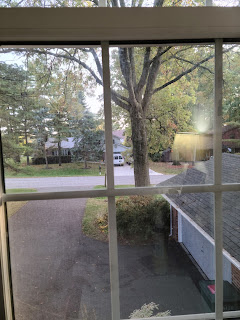

The view from my "office/classroom window"

On Tuesday,  Friday and Sunday afternoons about a dozen or so students come over to my house after school to train for our annual 10K Run.  We are doing the Autumn Squatch 10K Trail Run again this year, which is being held as a virtual event (we just send in our times and distance).  We run around our neighborhood for thirty minutes on the weekdays and increasing distances on the weekends. I cook four days a week (Tuesday, Wednesday, Thursday, and Sabbath) and so most evenings I'm busy making supper, spending time with the boys, attending various meetings via Zoom, trying to get some grading and planning done (Planning is especially laborious now, since everything has to be put on Google Classroom). I usually go to bed later than I want to. Making time to write is a challenge (which is why this blog is a week late).

There are things I like about this "new normal" at least, professionally. I'd always thought I'd be comfortable working from home and I am. I like that the students complete all their assignments digitally. Even when we go back to in person, I think I'd like to keep my assignments mostly digital. I like that when the students work independently, I can get some work done unlike in person, where I am still providing supervision and monitoring them to make sure they are on task even when I'm not engaged in direct instruction.  I like that classroom management is now so much less of a burden. The mute button is a wonderful thing. But even without that, I find that many of the students who would normally be discipline problems are quiet and say little.  They just don't seem motivated to "cut up" in the virtual space where they don't have a live audience.

There are also things I don't like. For one, a job that usually had me on my feet all day, now has me in a chair virtually all day. I miss interacting with the students and I feel sad for them that they are not able to be with their friends.  There are a few students that seem to be doing more poorly than they would if they were in person. But in general, the kids who excelled in person, are excelling at home. And those that didn't do much in person, still aren't doing much learning from home. In fact, even those with consistent internet connection problems tend to be the same ones that seemed to have problems staying on task and getting their homework when at in-person school in the Before Times. It makes me think that the lack of equity of the students learning from home was affecting them even when they came to school.  It is also hard to teach while both of my boys are learning online at the same time, though it's not as bad as I thought it would be. Ezra is surprisingly independent for a second grader and doesn't need my help as much as I thought he would. He does, however, come into my home office/classroom several times a day to ask when lunch will be or to announce it's snack time with no regard for whether I might be in the middle of a lesson at the moment. Beyond my work life, there's not much I like about the New Normal. I still pine for things like movies, in-person church services, concerts, and other gatherings. It seems many people have just gone back to living regular life--having gatherings, going out to eat, taking vacations, and visiting family. I feel keen to get back to those things too.

Let's take a look at the numbers.  As of yesterday, October 10, we had 7,725, 717 total cases of the coronavirus in the United States. This is about 500,000 fewer cases than I predicted, a total of 1,466,628 new cases in the past month and a 23% increase.  There have been 213,876 deaths from the virus. This is just over 12,000 fewer deaths than I forecast; that's a 14% increase and 25,475 new deaths in the past month. The charts below tell the story.  Though there has been an uptick since the start of September, at least so far the increase does not seem to be dramatic and may be leveling out.  And our deaths are virtually flat: a steady 5,000 people or so each week succumbing to the virus. 


Based on this pattern, I expect 9,502,632 total cases by November 10 and a total of 243,417 dead from the virus.

On to the states: Florida, Ohio, and Illinois all seem to posting moderate increases, with Nebraska maybe tacking down just a little bit. Hawaii's numbers are too small to make for a meaningful chart. I can tell you that island state started with over 1,200 new cases in a week back at the start of September and then dropped to by about half that much weekly. Hawaii has averaged about 691 new cases every week since September 12. Hawaii, though it has far fewer cases, has actually showed the greatest percent increase in cases over the past month, closely followed by Nebraska. Illinois and Ohio had the same percent increase but Illinois numbers were far larger, despite the two states having similar populations. I'm guessing this is largely due to the city of Chicago which I expect is responsible for a large chunk of Illinois' numbers.  Again no real improvement for anyone.


Total Cases:
Florida: 728,913 total cases, 85,054 new cases, an increase of 13%. This is more than 100,000 fewer cases than I predicted.  Prediction: 823,672 total cases by November 10, 2020.
Ohio: 166, 102 total cases, 36,317 new cases, an increase of 28%. This about 10,400 fewer cases than I predicted. Prediction: 212,611 total cases by November 10, 2020.
Nebraska: 50,394 total cases, 14,859 new cases, an increase of 41%. This is about 3,000 more cases than I predicted: Prediction: 71,056 total cases by November 10, 2020.
Hawaii: 13,641 total cases, 4,013 new cases, an increase of 42%. Prediction: 19,370 total cases by November 10, 2020
Illinois: 320,113 total cases, 69,276 new cases, an increase of 28%. Prediction: 406,543 total cases by November 10, 2020

The death rate in the states remains pretty steady as well. Florida and Ohio seem to be gradually trending down--very gradually,  while Illinois seems to be gradually trending up. Hawaii and Nebraska's numbers are far too low to show up meaningfully on the graph, but Nebraska loses about 22 people every week from the virus while Hawaii loses an average of 17 people each week. This seems about right as Hawaii's population is less than Nebraska's by about 458,000 people. Nebraska's (as well as Florida and Ohio's) deaths have zig-zagged over the past month increasing one week, and decreasing the next with the highest number of deaths this past month recorded in the first half of September. The 24 deaths this past week in the Cornhusker State were the third highest weekly count of the month for the state (or the third lowest if you're a glass half-full type of person). Hawaii and Illinois have posted steady increases since September 26, with both states posting record high numbers of deaths for the month this past week: 24 for Hawaii and 201 for Illinois. Despite Hawaii's lower numbers of deaths I'm concerned about their rate of increase. Illinois has almost ten times the population of Hawaii and the large city of Chicago but Hawaii's rate of increase was ten times that of Chicago. I know twenty-four doesn't seem like a lot, but for Hawaii it is a lot--a lot more than I think it should be for a state its size.


Total Deaths
Florida: 15,185 total deaths, 3,375 new deaths, an increase of 29%. This is almost 4,000 fewer deaths than I forecast. Prediction: 19,589 total deaths by November 10, 2020.
Ohio: 4,994 total deaths, 738 new deaths, an increase of 17%. This is about 70 deaths fewer than I predicted. Prediction: 5,842 deaths by November 10, 2020
Nebraska: 523 total deaths, 108 new deaths, an increase of 26%. This is 17 more deaths than I predicted. This is the second month in a row that Nebraska's death toll has exceeded my forecast. Prediction: 659 total deaths by November 10, 2020
Hawaii: 165 total deaths, 85 new deaths, an increase of 106%. This is the sharpest increase in deaths of the five states I've studied. Prediction: 340 total deaths by November 10, 2020.
Illinois: 9,234 total deaths, 829 new deaths, an increase of 10%. Prediction: 10,157 total deaths by November 10, 2020.

Sep 19, 2020

Angry: Soldier of Love


When it comes to racial issues the usual rules of faith don't apply.
That's the way it always seemed to me, and it had always been one of the most disconcerting and upsetting aspects of race in America.  When race came up in conversation I'd see people-black or white-completely abandon their faith principles.  It almost seemed like this was the one thing that could trump the love of Jesus..

So it was easy to believe an idea that I often hear these days--that focusing on issues of racial justice is a distraction from the gospel.  We don't need to get bogged down in all these divisive issues. Instead let's stay focused on preaching the three angel's message. After all, when we look at the ministry of Jesus, He wasn't divisive.  He didn't lead an insurrection against Rome; he didn't try to end slavery. I think it's worth noticing though that Jesus lived in an entirely different political and cultural environment than we do today.  There were no First Amendment rights.  There was no right to peaceably assemble or petition the government. There was no democratic tradition; there weren't even elections.  When it came to the policies of the Roman Empire there were two choices--go along or armed rebellion.  So to argue that Jesus "wasn't political" in His day doesn't necessarily translate to avoiding speaking out on the issues today.  Indeed Jesus  Himself, among others, was the inspiration for much of our modern day approach to nonviolent, peaceful protest. 

And you'll also notice that Jesus didn't take pains to avoid controversy. And in the end he was identified as the enemy of good, religious people and  He was killed by Rome as a potential insurrectionist. 
 
But I think we have to ask ourselves if we're really looking to Jesus as our model. Our call to focus on the gospel and not on social justice issues, is often really a call to complacency and acceptance of the status quo. This response is maybe less about fealty to the gospel and more about restoring the comfort of some Christians. Black churches seem to do just fine preaching the gospel and pushing for just laws. It's white Christians who seem like they can't focus on Jesus while someone is rattling on about racism.  It's been argued that excessive talk about racism hinders our ability to share the gospel because it upsets people and makes them uncomfortable. But I have to wonder if it isn't also true that ignoring issues of racial inequity or downplaying them might also upset some other people and make them distrust the supposed message of Jesus' love. Maybe it's a lot to do with who we are okay with discomfiting; whose comfort matters and whose doesn't.

While Jesus may not have seen government or society at large as the solution or the problem, He seemed to have a pretty strong idea of what kind of life His followers would live.  Many of the same Christians that view taking an active stand on issues of racial inequality have no problem taking a vocal, public, and unapologetic stand when it comes to abortion or religious liberty. They see no conflict between advocating for political action and their preaching of the gospel. If anything, they are inextricably linked. You don't hear people saying abortion is a "heart issue" and that "rather than pass laws we need to focus on changing individual hearts."

Jesus showed a strong affinity for the marginalized. It's how he described his ministry (to the poor, the prisoners, the blind, the oppressed--Luke 4:18) and it's how he describes how His followers will be identified in the judgement (those who serve the interests not of the culturally dominant and powerful, but the "least of these" Matthew 25: 31-46). 

When I look at Jesus as a model for dealing with the controversies of the day, I think it's safe to be active in seeking to support the marginalized. Not only safe but necessary. I don't think Jesus would say the ends justify the means. I know that Jesus does not advocate hating those who mete out injustice. I know He does not support lashing back in like manner. I know that Jesus would prioritize the needs of those He's trying to reach over a personal sense of self-congratulation.  I know that Jesus has no interest in setting up His Kingdom on earth. He's not calling on His followers to demand that their religious values be enshrined in civil law. But feeding the hungry, healing the sick, and  yes, supporting the oppressed are not about codifying one specific religion's beliefs.

I don't like to upset people. That's one of the reasons it took me so long to finally speak my heart on race in America. And for a long time I associated not upsetting people with being Christlike. I've come to realize that taking care not to upset people was not Christ's way (and of course neither was it His goal--as has become quite fashionable today--to go out of His way to upset people).  Jesus upset people.  He did things that He knew would upset people. But He did it in love and out of love. He did it in support of those that the dominant culture of His day had rejected and devalued. He did it to call out the hypocrisies of the supposed "good guys" who traveled across land and sea to make a convert only to make that convert twice the son of Hell they are (Matthew 23:15). Would Jesus wear a Black Lives Matter t-shirt? I think He would, because it would let those in this country that have been told in so many ways that they don't matter that they do matter in His eyes.


 This is the end of the Angry series. I've covered all of the topics I jotted down right after my first post--everything that I'd been hiding away for decades that I finally wanted to say aloud, plus a few other things that came to mind along the way.  If there's something else I feel needs to be said, I'll say it. But for now, I'm done. My next project will be to tell my personal story--perhaps in book form.

But the work is not done. While it is still daylight, we've got to be out there "on the battlefield for My Lord", doing His work.  We are called to be soldiers in His army; soldiers of love. And I'm determined to do my part.

"He has told you, O man, what is good, and what does the Lord require of You, but to do justice, to love kindness and to walk humbly with your God."
                                                       --Micah 6:8

Sep 5, 2020

The Corona Chronicles: An Unknown Autumn

 And we're back. A mere two days after the close the Dispatches from Coronaville, the Corona Chronicles has arrived. This won't be a long post--basically just catching up on my predictions from a month ago and laying out the plan for this new once a month (at least) series.

I had predicted a rougher month than what transpired. Despite my expectation of a rash of new cases due to school reopenings keeping our rate of increase steady, the increase ended up being less than projected. Despite reports of virus spreading across college campuses, so far these outbreaks don't seem to have led to wider community spread. Perhaps we'll see that yet, as autumn progresses.  We just don't know. Also, the K-12 school reopenings--at least where they've happened--don't seem to have led to a new surge either. I'm not sure what will happen between now and October 5. I saw a rodeo going on this evening on our drive home from a visit with Barbara's mom in Dayton.  The stands were packed and it didn't look like anyone was wearing masks. But this area of the state is Trump strong and I'm guessing they leave precautionary measures to the weepy, trembling liberals. I'm sure the virus will be intimidated by their bold stance and find someone more fearful to infect.

Here's where the numbers are today, September 5, 2020 in the United States. We've had a total of 6,259,089 COVID-19 cases, representing 1,486,602 new cases in the past month and 31% increase in the number of cases. The percent of increase dropped by more than half.This is, then, a good 1.5 million less than the 7.8 million I forecast we'd see by this time. Thankfully deaths are lower than forecast as well, though by a much closer margin. A total of 188,401 people in the U.S. have died from COVID-19. That's 31,282 people in the past month, a 20% increase (only 1% less than the previous month). My prediction was off by less than 2000.  With the same rates of increase I would expect 8,199,407 total cases by October 5, 2020 and 226,081 deaths.

I'm going to keep my benchmark states and add two: Hawaii, because, well, I just love Hawaii and also because it's had far fewer cases than much of the rest of the U.S., and Illinois, the home of one of my closest friends and favorite cities, and the state with the population closest to Ohio's. (I was surprised to learn that Ohio is the seventh most populous state in the union). There'll be no graphs this month but I might have something in October. We'll see.  

While my prediction was way off for Florida--there were about half as many total cases as I'd predicted, they weren't far off for Ohio and Nebraska, only slightly lower than forecast. It's quite remarkable to look at Hawaii's numbers. I thought Nebraska had low numbers, but Hawaii's are minuscule by comparison. And it only has 633,000 fewer people than Nebraska. Illinois meanwhile has twice as many cases as Ohio, though a population that's only a million and some change larger rather a twice as larger.  Take a look at the numbers.

Florida: 643,859 total cases, 146,537 new cases, a 29% increase. Prediction: 830,578 total cases by October 5, 2020.

Ohio: 129,785 total cases, 34,679 new cases, a 36% increase, a little more than 3000 less than predicted. Prediction: 176,507 total cases by October 5, 2020.

Nebraska: 35,805 total cases, 8,778 new cases, a 32% increase, about 900 less than predicted: Prediction: 47,263 total cases by October 5, 2020.

Hawaii: 9,448 total cases

Illinois: 250,837 total cases


Florida's deaths were significantly less than I predicted. Ohio's deaths were also just a little lower than forecast and Nebraska actually lost more people than I thought they would. Again Hawaii has had less than a hundred people die from the virus and while Illinois has lost twice as many people as Ohio.

Florida: 11,810 total deaths, 4,409 new deaths, an increase of 60%, about 4,200 less than forecast. Prediction: 18,896 total deaths by October 5, 2020.

Ohio: 4,256 total deaths, 686 new deaths, an increase of 19%.  I was 135 deaths short. Prediction: 5,065 total deaths by October 5, 2020

Nebraska: 415 total deaths, 76 new deaths, an increase of 22%. This is 12 more deaths than I predicted. Prediction: 506 total deaths by October 5, 2020

Hawaii: 80 total deaths.

Illinois: 8,405 deaths

Sep 4, 2020

Angry: Untangling the Roots of Racism


Racism isn't (always) about hate.
This is a controversial idea. I've had very heated arguments with both black and white people over it.  One person, a black man, went several rounds with me on Facebook a few months back. He found it deeply offensive that I'd even consider not ascribing hatred to every person who holds racist views. I ended up compromising by conceding that racism is hateful, but I stand by my position that not all who hold racist ideas have "hate" in their hearts. On the other hand I've had white friends who bristle at the notion that racism might not be always about hate. It's because they know they "don't hate anyone" and therefore should be absolved of any association with racism. My suggestion that you can love a person of color and still be racist calls them to a reckoning they feel doesn't apply to them. In one conversation I ended up by conceding that maybe we need another word--like anti-blackness since racism is tied to hatred so closely in the minds of so many.  But I stand by my thesis that racism isn't always, or in today's society, even often about hate.  Having black friends, liking black people, even being married to a black person does not necessarily mean you do not hold racist views.   In today's post we will explore what racism is, where it came from, and what we can do about it.
 So if racism isn't always about hatred then what is it? Essentially this entire Angry series has been about exploring this question. In summary:

Racism is about our views of groups not of individuals.  It's not how we feel about the Exceptions, it's how we feel about the Rest. To many of the white people I knew growing up, I was the Exception not the Rule. So clean cut, so well-spoken. Isn't that nice.  The Rule is where racism often lies. And the Rule is generally negative because. . .

Racism is about fear.  Hear the words of Dylann Roof who, in a racist rage, murdered nine people: "You're raping our women and taking over our country."  I don't know of anyone who would admit to this young man's words resonating.  On a conscious level I imagine they only resonate with a few fanatics on the fringe. But the fear that can't be, or can't be allowed to be articulated is still there.  I may not hate you, the individual black person that I know and like, but I'm afraid of a horde of Them. Taking our jobs, changing our culture.   While it's easy to love individuals--it always has been, even in the time of slavery and segregation--it's harder not to fear a Group.  And many still hold inchoate fear. They are unnerved and "concerned" about black people as a group. Racism is in fact about a very specific kind of fear.  It's the fear of losing power.  Because. . .

Racism is about power.  Who has power and who doesn't.  But here in the United States our divide has never been about two groups struggling for the upper hand. This is not the War of the Roses. This is not the U.S. vs the USSR. It's not Northern Ireland.  Despite what we're often told, racism is not exclusively a personal issue or a heart issue. It is a societal and cultural issue. We don't need "racial healing" or "racial reconciliation" in this country. This isn't a situation in which black and white people have been unfortunately feuding for many generations and now it's time to bring  both sides to the table and work things out. There's no "both sides" here. Each side does not need to "do some work" and find it in their hearts to "forgive." White people haven't been wronged and thus cannot offer forgiveness. Black people have already had the value of forgiveness drilled into us by the larger culture that realizes that if black people can't forgive, we are all in trouble.   One group of people have dominated another group of people for most of this country's history. What's needed is justice.  What's needed is change. What's needed is a reevaluation of what we assume to be true in our culture. Because. . .

 Racism is about superiority.  It might seem that believing that you are superior to someone else must be the equivalent of hatred.  I mean, isn't  it obvious that you hate someone that you do not view as your equal?  But think about this for a minute.  People love their dogs (this was the comparison that really got under the skin of the guy I was debating on Facebook; he couldn't separate the upcoming analogy from believing the analogy to be true).  They are man's best friend after all. We grieve them when they die, some even call them "family members." But you'd be hard pressed to find even the most ardent dog lover insist that dogs are equal to humans and should be  granted the same rights and privileges we have.  And just watch what happens when the family dog bites the family child.  Suddenly it becomes very clear who is more valued.  I'm not suggesting that any but the most radical racist sees African-Americans like dogs. But this wasn't always the case. Not too long ago this kind of thinking was a given. This "I love you but I am above you" thinking was certainly prevalent among many slave owners during the days of slavery. It's no accident that some of the slurs used against black people were designed to communicate not hatred, but a message of their "place" in society. Boy or gal are not hateful words in and of themselves. My sons are boys (right now). My saying that does not communicate that I hate them. It's an appropriate description of them mentally, physically, and emotionally.  Now consider the slave owner who says of  his beloved "Jim," "We've had our boy Jim in our family for most of my life and he's just fantastic."  That statement while technically "loving" and appreciative is horrible because Jim, hair grayed, body stooped with years of labor is not a boy--not emotionally, not physically, not mentally. He is a man and every bit the equal of the "master."  Of course few people countenance that kind of thinking now.  But I am making the point that if one can con consciously view someone as not their equal but without an ounce of "hatred" in their hearts, they can certainly do so unconsciously. And while we've dismantled slavery and legal segregation, what's left are the beliefs that once justified those systems. Because. . .

What many of us don't realize is that racism had its roots in this country not in hatred, but in greed.  Racism was an ugly but practical by product of rationalizing race-based slavery. Slavery in the New World started out the same way it had already existed for millennia (and the way it still exists illegally today, where human trafficking preys on the vulnerable). One group was overpowered by another group and enslaved. In Africa, one kingdom defeated another kingdom in battle and enslaved the losers, selling them to European slavers gathered on Africa's West Coast. Meanwhile the Spanish were enslaving the defeated Native Americans they encountered in the Caribbean, Mexico, and central and South America. But over time, it became apparent that it was economically useful to have a class of people, easily identifiable, who would be permanent slaves. The Native Americans were dying out from European diseases.  Africans were easy to distinguish, immune to European diseases, and in the New World mostly already slaves or indentured servants.  And then think of the genius: If one's "race" was tied to their status as slaves that meant that the children of the slaves you had would be your slaves as well.  It's like if your money could give birth to more money. It was too good to pass up. And so gradually slavery came to shift from "You're my slave because we defeated you in battle; it could just as easily have been me but luckily it wasn't" to "You're my slave because you are 'black' and I am 'white.'  While theoretically you could be free if I decided to grant you that, I could never be your slave because of who I am and who you are."  Race-based slavery was institutional, economic, systemic not individual or emotional in nature.  The emotional aspects came later and were born of rationalization not blind hate. Slavery of any kind is unChristian. It's wrong. And race-based slavery is even worse.  So in order to sleep at night, in order to view oneself as a "good person" economic necessity wasn't enough. There had to be a "reason" that black people were "supposed" to be slaves.  And so came the rationalizations: they're "savage", in need of Christianizing and civilizing, they are childlike and best suited for manual labor rather than intellectual pursuits, they are dangerous and need to be contained and controlled.  Once white people and white society adopted these beliefs racism as we know it today was established.  

So where does hate come in?  It comes when those who have been assigned a station in life dare to try to rise above it. We are angered by those who challenge our authority: The insolent child. The biting dog. That anger--and fear--over time can and does coalesce into hatred.  And why do we see less "hatred" today than we did in the past? Because the idea that black people "belong" in a lower station in life is no longer socially acceptable.  Most of the obvious institutional scaffolding that justified the rage and the hatred has been taken down. White people are no longer enraged by the very sight of a black person who isn't in a subservient position.  You can't get angry and ultimately hate someone for not holding to a system you've disavowed.  But you can be angered by threats to the system that still remains. I find it fascinating that some of the most vitriolic responses to talk of racism is when we talk about it's systemic nature.  It's odd because it would seem that this would be good news right? We're not blaming any individual person--we're not blaming you. But people hate the concept of systemic racism. It's a lie, it's a myth. It's just a few bad apples. I don't hate anybody. All this protesting is just causing division.  Those are the cries of people unconsciously enraged by black people stepping out of the place they are now currently assigned and messing with the way everything's been set up.  Come at me if you want, but leave the system--whether it's slavery or segregation or what's left of these in our society-- leave the system alone! 

Dealing with racism today ultimately will boil down to destroying it in the same the way it was built. Racism wasn't built out of the hatred in people's hearts. It won't be destroyed by the warm fuzzy feelings in the heart. It will be destroyed however by love-- a sturdy, working, practical, and pragmatic kind of love. If racism was born out of greed, it must be killed through unselfishness and generosity of spirit. If fear has motivated racism, courage must be its antidote. In a sense it is individual work--not just laws passed and institutions challenged. But it's work that requires moving past the easy targets of racial hatred, to the more subtle issues of fear and selfishness. We must root out racism entirely, not just lop off the ugly branches and leave the nicer ones. Together we must take institutional, practical measures that dismantle a system built for the benefit of one group at the expense of another, and rebuild in a way that allows for true power-sharing and equity.  (By that I don't mean "socialism". ..geez. Come on, people).


Sep 3, 2020

Dispatch from Coronaville: The Last Dispatch and What Comes Next


Where do we go now? That's the question as I conclude this blog series that began a lifetime ago on March 19.  When I started this blog series I was looking at China as our model and expecting a similar trajectory. Two months of struggle and then coming out into the light around the end of May or early June.  Coronaville was never intended to be a permanent settlement. I saw it as a war-time encampment that would eventually pack up stakes leaving behind nothing but faded grass circles where the tents used to be. And indeed it may yet be that, but this is turning out to be more like the Civil War, which the North thought would be over in a few months time.  It appears that this is going to drag on. I don't know that there's much more to say every three days about the COVID crisis. I am prone to repeating myself and that will definitely happen if I keep sending back Dispatches from Coronaville.

My plan is to begin a new series: The COVID Chronicles, which will appear at the very least, on the fifth of each month (The first one will be out this weekend!).  I'll be free of the every three days straitjacket and if I have something that I find I want to say before my regular fifth of the month entry I'll throw in an extra post. This is an approach for the long hall, for the "duration" as they used to say during World War II.

Personally, I'm beginning to get a sense of what the "new normal" is going to look like for me and my family. I know back in May I'd said we'd be holed up until new cases have gone down steadily for two weeks, and by large that's still true but what it means to be "holed up" seems a bit more flexible. Already we've loosened some restrictions.  We've had a few outdoor socially distanced gatherings for a handful of Elijah's friends. The boys went to a store with their mom the other day for the first time since before March 12. We're really hoping to go camping once or twice this fall.  

Why the change?  For one, our numbers are down in Ohio--at least that's the official word (to be honest when I look at the numbers myself, "down" seems a bit generous), at least for now, which helps.  Second, I feel like we have a better sense now than we did at the outset of this thing of what it takes to keep ourselves safe (or safer anyway). Masks and social distancing are vital. Beyond that, we remain committed to avoiding large crowds in enclosed spaces for long periods of time.  Within those limits, there's room to move a bit, room to live. Third, and I have to be honest here, there's a part of me that is becoming acclimatized (perhaps desensitized even) to living in a pandemic. Humans can only maintain a heightened state of emotional excitement of any kind for so long before it begins to wear off.  Even the most of horrible of circumstances can become normalized over time. We are shifting from crisis mode to chronic mode.

Today in the United States our COVID case total stands at 6,161,915, of which 120,030 were new cases added in the last three days. This about 5, 200 more cases than I predicted. We have had a total of 186,584 total deaths, and 3,134 of those people died in the last three days. This is about 1200 more deaths than I predicted. Since this is my last Dispatch I won't be making any new predictions. I'll be continuing to follow the numbers closely, recording our daily totals for our county on my offline graph.


New cases are back up again.  All three states posted sharp upticks in new cases and all three seem to be looking most likely at plateaus that are higher than they were earlier this year.

Total Cases

Florida: 637,005, total cases, 2.9% of the population

Ohio: 127,112 total cases, 1.1% of the population

Nebraska: 35,052 total cases, 1.8% of the population


Deaths are up as well. Nothing much new to report here.

Total Deaths

Florida: 11,649, a rate of 1.8%

Ohio: 4,226, a rate of 3.3%

Nebraska: 408, a rate of 1.2%


Sep 1, 2020

Dispatch from Coronaville: The Swedish Conundrum


How is Sweden doing it? Perhaps more accurately, what is "it" that Sweden is doing?  Can we do it too? Should we? It's really hard to say. Sweden has been both praised and condemned for it's unusual approach to the coronavirus pandemic. It's lack of mask mandates, lockdowns. and school closures are source of envy or dismay depending on your outlook. I'm not going to spend a lot of of time exploring Sweden's approach. There are quite a few good articles that do that and I've included links to some of them here. (This article weighs whether Sweden's COVID policy was a disaster or object of admiration. And this one examines some of Sweden's unique features that make it a "special case.") The one thing that's clear is that's its not really clear whether Sweden's approach is effective or not. As such Sweden becomes the perfect canvas for us to project our deepest hopes or darkest fears about what is (or isn't) the ideal way to combat this virus.

What I will do is share a few interesting numbers comparing the United States and Sweden. First I should point out how I came to start thinking about Sweden in the first place today. I was skimming through the New York Times database of global cases and deaths. I was curious as to which nation had the slowest spread of the virus. To my surprise, Sweden was third from the slowest, with only the tiny nation of Luxembourg and the evening tinier city-state, Vatican City spreading the virus more slowly. Amazing! Furthermore, only 0.8% of the population (about 84,000) have been infected with the virus, compared with the United States, where 1.8% of the population has been infected. And while the virus is still spreading in the United States, in Sweden it seems to have come to a standstill.  Sweden has a population of 10,000,000--fewer people than the state of Ohio, and it's had 40,000 fewer infections.  This is Sweden's success story. COVID-19 is just not spreading aggressively in this country despite it's lax approach to restrictions. Oh, it sounds like a dream!

But there is a dark side to Sweden's story as well.  Though the nation has fewer people than Ohio and the virus has not spread as far or as rapidly, the Swedes have still suffered almost 2,000 more COVID-19 deaths than Ohio has.  Furthermore, the percentage of their population that has died from the virus is exactly the same as the United States (albeit a small percentage, 0.06% to be precise). Sweden is losing the same percentage of its population as the world leader in deaths. When you look at the percentage of Swedes who tested positive for the virus who ended up dying, the picture is even more bleak. In Sweden 6.9% of those who tested positive ended up dying, while in the U.S. 3.% of those who tested positive ended up succumbing to the disease.  Granted, as elsewhere in the world most of those who died were elderly (and these days its quite popular with many in the supposedly pro-life crowd to shrug those deaths off--they were gonna die anyway, right?).  But it's interesting that in Sweden, the restrictions are light, the spread is slow, but man--if you get it, you're in trouble (But you probably won't get it).

I'm wondering though if I've been looking at this all wrong. I wrote the above last night, but this morning as I read over what I'd written again, I realized that maybe Ohio is exactly the right comparison for Sweden. Perhaps it makes more sense to compare nation to state instead of nation to nation. When we do that, Sweden doesn't look like such an outlier. 40,000 fewer cases is not huge, not when Florida has 623,000 cases, 500,000 more cases than Ohio but only about 10,000,000 more people. Likewise a difference of 2,000 deaths is not that great either. Maybe the answer is simply that Sweden's unique characteristics such as the high number of single person households and lower population density, led to a slightly lower and slower spread despite the lack of restrictions.  And likewise Sweden has slightly more deaths than Ohio due to also to the lack of the same restrictions. Sweden's unique factors balance out it's unique approach resulting in essentially a wash.  Perhaps Sweden is not so special after all. When you put it all together perhaps Sweden ends up being more or less, like Ohio. What's also clear to me given the Swedish advantages, they could have done a lot better. I'm no expert, but maybe this is the solution to the Swedish Conundrum.

Meanwhile, back in the United States, yesterday, Monday, August 31, we crossed the six million case mark with 6,041,885 total cases. It took only a day longer than I predicted to get to this number. I project we'll hit seven million total cases by September 21.  Of this total, 113,865 are new cases in the past three days and this number is about 41,000 fewer than I predicted. Deaths have reached 183,450 in total with 1,766 new deaths in the previous three days. This number was also less than I predicted by about 2000. It's also worth noting that for the first time ever the rate of increase for deaths dropped below 1% (just barely, at 0.997% ).  What I think we are seeing is a plateau developing in the United States for the number of cases (that's what what the New York Times seven-day average graph shows as well).  Unfortunately, the numbers are plateauing at a much higher level than they did in late May and early June.  The American case story appears to be a first wave followed by settling at a higher plateau, followed by another wave and another still higher plateau. That appears to be the case with the nation as a whole, but the story with individual states is a little different as we shall see.  

What I wonder about is what is happening with deaths.  Yesterday's number of new deaths in a three day period are almost exactly the same as on June 20. Just ball-parking the numbers, it appears that the U.S. COVID death rate has stayed fairly consistent since it's spring peak when we saw over 12,000 deaths in the U.S. in a three day period. We've not approached anything like those highs since, not even through this summer's explosion of new cases. This could be the template for the coming months, ever higher waves and plateaus of cases, with a steady thrum of deaths ranging from two to four thousand every three days. Extrapolating outwards that could mean anywhere from 243,000 to 487,000 deaths from COVID by next March, which would account for 10 to 20% of the total deaths from all causes in that time frame (using 2017 data here, for comparison). This would make COVID-19 the third leading cause of death in the United States right behind heart disease and cancer.  Of course a big question mark is what hospitalization rates have looked like and what the prognosis is for those that get COVID and recover. How many bounce back to completely normal; how many deal with long-lasting and even life-long issues from the disease? Since I didn't track that data I can't really say.

As for my final prediction for the Dispatch from Coronaville series, I project that by Thursday, September 3 we will have 6,156,680 total cases in the United States and 185,261 total deaths.


The states present an interesting picture. It's hard to tell what's happening. They could be plateauing or they could be in a slow decline. If our new cases are plateauing then Florida and Ohio will reflect what I seem to be seeing with the U.S. as a whole--a new plateau that's higher than the one in late spring and early summer. Nebraska on the other hand appears to be plateauing below the spring high case counts. You just can't tell what's happening when you're in it. Only in hindsight is the pattern clear. Everybody's down this time around but again, that's neither here nor there unless a general pattern becomes clear over time. 

Total Cases

Florida: 623,463 total cases, 2.8% of the population.

Ohio: 123,157 total cases, 1.1% of the population.

Nebraska: 34,046 total cases, 1.7% of the population.


Deaths are different story in each state. Florida has yet to return to it's pre-summer new death counts--and it's too soon to say if the state will get back there. Right now yesterday's toll while lower than it's been since June, would still be the second highest number of new deaths had these numbers registered in April. Ohio meanwhile seems to reflect what's happening in the nation as a whole with deaths seeming to have plateaued at a much lower count than the highs of the spring. And a careful examination of Nebraska appears to reveal a similar pattern as well.

Total Deaths

Florida: 11,186, a rate of 1.8%

Ohio: 4,138, a rate of 3.4%. I think it's worth noting that Ohio's death rate is lower than Sweden's by more than half. That's sure evidence that Sweden's hands-off approach is not without a significant human cost.

Nebraska: 400, a rate of 1.2%