Mar 22, 2022

92: The One Where We Went As Friends


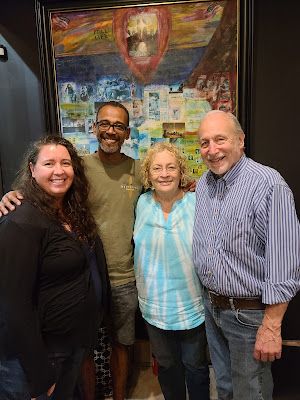
With friends, from Left, Pamela Foard and Geri Haupt, and my date, Chandra Maloney, who went with me "as friends." Junior-Senior Banquet, Sunday, March 22, 1992

 It took me more than twenty-five years to figure out that the Junior-Senior Banquet was supposed to be a kind of replacement for prom.  In the way that Adventists have their veggie meat, and Pathfinders instead of the Scouts, this was a kind of "veggie-prom", where the dancing was replaced with dining. Better the sin of gluttony, than of lust, I suppose?

I don't think the replacement really translated well though. I tended to focus more on the Valentine's Banquet as The Romantic Event of the Year.  If I hoped to get lucky (not really lucky mind you, not like prom night lucky, if you know what I mean), Valentines was where I expected it to happen.  I think all four years I plotted and schemed over who to invite to the Valentine's Banquet--generally someone with whom I hoped "something more" would develop.   While I had a nice time at the Valentines Banquets junior and senior year, the only thing that developed were new friendships--but nothing more than that.  And that was fine.

The future Mrs.  Fulford, Raelene McDowall was my date to the Valentines Banquet my senior (and her junior) year.

There seemed to be a lot less pressure on the Junior-Senior Banquet for some reason, and both junior and senior years I was content to go with my date "as friends" as we used to say.  Junior year was a bit fraught, as my intended date elected to run off with her boyfriend the night before the banquet, leaving me dateless. I don't recall being particularly mad about it--I guess I wished her well on her romantic escapade.  Thankfully, Anita Hodder stepped in at the last minute to be my date (as her boyfriend was a sophomore and wasn't allowed to go to the banquet) and we had fun time.

Me and Anita Hodder at the Junior-Senior Banquet, our junior year, Sunday, April 21, 1991

The banquet our junior year was held at some sort of plantation, I think.  We all thought it was a hoot to have the boys and girls switch roles for the official banquet photo.

In public schools, the kids head for the dance floor.  At Forest Lake Academy we made a beeline for the buffet table.  From Left to Right, J Carlos and Jennifer Everett, Sandra Rivas, Carissa Berard, Geri, Anita and Me. I'm almost certain Chandra was the one who took this photo and filled that empty chair.

For my senior year, I again decided to take my date "as friends."  And this time I didn't take a chance on inviting an acquaintance who might bail at the last minute. I asked my best friend, Chandra, to be my date and she happily agreed.

One of the risks of going with someone "as friends" though was the possibility that they might become more than friends with someone else and want to go with them instead. I was worried about this with Chandra (perhaps still a little gun shy from the previous year's debacle).  There  appeared to be some mutual interest developing between Chandra and another schoolmate and ten days before the banquet I raised the issue with her during A&P class.  We typically wrote notes to each other in my journal to avoid getting in trouble with Mr. Viar.  Here's our exchange:

Chandra, 

How are things going with ****. (I’m not asking to be nosy. There is a reason.)


What do you mean? Fine.


I mean is he still with that ‘other woman’  Yes.


Oh ok. Never mind.


Okay--No--tell me why.


Well I’m relieved personally for selfish reasons. I thought if

they broke up and you guys were getting together you’d want

to go with him to the banquet.


No--He’s still going with her, but even if he

wasn’t--I would still go with you.


It meant a lot to me that Chandra was willing to prioritize our friendship over a romantic possibility. And it turned out to be a really fun night.  Unfortunately, there’s not a lot I remember about the evening and I wrote only a few brief lines in my journal that day, noting: “Tonight was the banquet, Junior-Senior Banquet. I went with Chandra and we had a great time.”  The details are sketchy for the most part--Chandra’s mom reminisced on Facebook about how impressed she was that I came to the front door to pick up Chandra for our date, instead of coming through the garage like I usually did. I’d forgotten that.  We went to Medieval Times, the Middle-Ages themed dinner show restaurant. It wasn’t the most romantic venue, to be honest--watching jousting matches and sword fights while feasting on medieval food on rustic platters and drinking “ale” from tankards.  Even the official banquet photo was weird, with each couple posed up next to a plastic statue of King Henry the VIII glowering at us like an unhappy third wheel.

But the one thing I’m not hazy on is that I had a really, really good time. I had so much fun with Chandra. I realize now that Chandra had a great time with me too.  In 2020, when it was all the rage on social media to share high school photos of oneself in “honor” of those poor class of 2020 seniors, Chandra sent me a private message asking if I had a copy of our official banquet portrait that I’d be willing to share with her. That was the picture of her senior self that Chandra wanted to share with the world.  She posted it and reminisced on what a nice time that was.  I’m glad that evening meant so much to her. 

My "prom date." This was the photo Chandra asked me to send her.

What I remember most about that evening was actually the drive home. Chandra and I sat side by side on the shuttle. Raelene, my date to the Valentines Banquet just the month before, was sitting one row up and across from us and I remember exchanging sarcastic quips and joking insults with Raelene, while Chandra laughed and laughed. I remember I felt a jaunty confidence, a sharpness of wit, that came from feeling really safe. I felt safe with Chandra by my side and on my side.  That's the advantage of going to prom--veggie or not--as friends.

Some pictures of the other couples--and friends--at Junior-Senior Banquet, March 22, 1992:

Rees Franklin & Susan Scott.  They went "as friends."

Kristi Van Nostrand and Mark Niemeyer

Raelene McDowall, Jennifer Burrill, Lena McDowall (who was my Valentine's Date my junior year), and Susan Scott

Chris Cotta and Carissa Berard on the shuttle bus on the way to Medieval Times

Steve Jeffers and Jennifer Everett Jeffers.  They may be the only pair that went to Jr-Sr Banquet in 1992 that is a couple today.

Jeff O'Connor and Stacy Cotta


Mar 19, 2022

The One Year Bible: A Man's World


The Midianite Women Led Captive by the Hebrews, by French painter James Tissot

For most of the history of mankind and in most places around the world, women have gotten a raw deal.  The Bible is no exception.  The Israelite culture was highly patriarchal, and women generally held a subservient role in the culture. For example, a woman's vow to the Lord could be invalidated by her father or her husband (Numbers 30:3-16).  If dad or hubby said no, that was that--she was off the hook for any commitment to God she might have made (They did have to object quickly though.  If they didn't act quickly to veto her, then the vow would stand).

Occasionally we find examples of women getting a win--getting a privilege that was typically reserved for men.  Such was the case with the daughters of Zelophedad: Mahlah, Noah, Hoglah, Milcah, and Tirzah.  These women were of the tribe of Manasseh and they had no brothers. They requested that they inherit their father's property as man would. so that his name could be carried on.  The Lord not only approved their request, but also extended it to apply to any man in Israel who had only daughters (Numbers 27:1-11). A man no longer needed a son to pass on his inheritance.  In the absence of a son, the daughter would do.  At the end of the book of Numbers an amendment to this rule was made stating that a daughter who inherited property had to marry within the tribe so that a tribe wouldn't lose land allotted to them. It's a little win, sure, but it's a start, right?

Unfortunately, it was more common for women to lose, according to Scripture.  We see this in the truly horrifying story of the conquest of the Midianites found in Numbers 31.  The more I reflect on this story, the worse it gets.  There are so many things just "off" about it.  From the fact that the Midianites were the people of Moses' in-laws to the lack of clarity as to why the Midianites were slated for destruction when it appears that it was the Moabites were the ones that caused Israel to go astray. You kind of have to read between the lines to figure out that the Midianites had also been saboteurs advised by none other than Balaam (see below) who had figured if you can't curse the Hebrews, get them to curse themselves. But to me at least, the worst part is what happened to the poor Midianite girls. 

Here's what happened. The Israelites slaughtered the Midianites (though clearly not all of them--because they were still around during the time of the Judges. Maybe this was just a local clan of Midianites), sparing only the women and children. Moses is angry.  "You were supposed to kill everyone," he fumes.  He orders the Israelite soldiers to kill all boys and any women that had had sex, leaving only the virgin girls behind. These commands are followed and the author of Numbers tersely records the number of girls left behind to a live a life of slavery--32,000.  32 of those girls--0.1% of the total were given directly to Eleazar, the high priest (Aaron's son and successor).  I couldn't help wondering what on earth Eleazar and his family were going to do with 32 girls. It seems unlikely that the girls were raped--especially since it was sexual sin that had led this massacre in the first place. I guess they just became ordinary slaves.  

I suppose these girls were "lucky" to have avoided the fates of their parents and brothers.  But it still seems so awful.  Can you imagine what it must have been like for them--to have watched their mothers killed before their eyes?  And to have to live the rest of their lives in servitude to the people who killed them? My only comfort in this horrible story is in God's absence.  Yes, God directs Moses to "take vengeance" on the Midianites, as his one last task before he dies. But those are the last instructions we hear from God in this story.  The command to kill the women and boys, the consignment of the virgin girls to slavery--that was all Moses.  All throughout the books of Moses it's clearly stated when God gives commands. And then there's no such statement in this story. That only makes sense to me, because I don't see God in these horrific actions

Highlights of Numbers 19-35

  • Moses Strikes (The Rock) Again
  • The Bronze Snake
  • Early Conquests on Canaan's Borders
  • The Strange Tale of Balak, Balaam and the Talking Donkey


Fun Facts

  • Did You Know about Cozbi's Sexual Misconduct? (No, that's not a misspelling).  We're not talking about a once beloved comedian. We're talking about Cozbi the daughter of the Midianite clan leader, Zur. I remember when I first started watching Game of Thrones, there was something about it that reminded me of the Bible. Now I realize, it was stories like this one.  In act of brazen rebellion, one of the Israelites, a fellow by the name of Zimri brought Cozbi into his tent in full view of Moses and everyone. I'm not sure what Zimri was thinking,  or what Cozbi's complicity was in all of this. A plague was ripping through the camp, as punishment for widespread dalliances with Moabite women.  Moses had just instructed the leaders of Israel to put to death all those involved in the hanky panky (which appears to have been tied directly to the worship of Baal).  Zimri seemd to think this was the perfect time for romance. Talk about a failure to read the room!
  • Anyway, Aaron's grandson Phineas was all like "Oh, helll no. . ." and he grabs a spear and according to the Bible "thrust the spear all the way through the man's body and into the woman's stomach" killing them both. Very, GoT, that. Whether Zimri and Cozbi were merely embracing or already engaged in full-on intercourse at the moment of their death is left to the imagination.  The plague stops on account of Phineas's actions and he is applauded for his zealotry and given a special reward by the Lord.
  • Did You Know about Balaam's Plan B?  Who was behind this mass seduction of Israel that lead to plague and spear stabbings? None other than Balaam.  This was the guy that Balak, the king of the Moabites had tried to hire to curse Israel for him.  Balaam was unable to provide the curses Balak wanted, but he hatched another plan to destroy the Hebrews massing on the border of Canaan  The Bible credits him with sending in the hot girls of Moab and Midian to lead Israel into the titillating world of idol worship.

What Stood Out to Me

Ok, If You Insist, But I Don't Recommend It


"Now Balaam he had a donkey
Who was gentle and true and kind
And the donkey saw an angel with a sword
So he slipped old Balaam past him
And when he done it three times
Well Balaam got so me mad he beat the donkey
And so the Lord
Well he gave the donkey language
And the donkey plainly brayed
"Well there's an angel about to strike you from the path"
Then old Balaam's eyes were opened
And he realized he'd been saved
By his donkey from the angel of God's wrath"

                                                  --Rich Mullins, "Who God Is Gonna Use"*

One of the things that can be a bit confusing about the story of Balaam is that God seems to contradict Himself. First he tells Balaam, "No do not go with King Balak's men. I don't want you messing with My people.  But then when Balaam asks again, God says, "Go ahead and go, but you're only going to do I want you to do."  But then, God sends an angel to slay Balaam for going ahead even though God had said he could.  What's up with that?

Well, to me, at least, it kind of made sense. I felt I could relate.  There have been many times when my kids have asked me if they can do something. Initially I say no, but then they ask me again.  And my response is generally, "Well, okay, you can do it.  But I don't support it and I don't recommend it."  To me that's what God's "permission" was like in this story.  It was given reluctantly, because Balaam clearly really wanted to do it. I think when the angel of God's wrath showed up on the path, and Balaam's donkey presumably saved his life, that was God warning Balaam again--"Listen, man, just to be super clear:  this is really bad idea. I do not support it. Just know, you are continuing AGA (Against God's Advice)." Now of course God is nothing like me, but it's the only way I can make sense out of this story.

Balaam's said he would do what God wanted.  But his heart wasn't in it, and given the opportunity he went ahead, despite knowing God wasn't happy with him. He also went knowing that he was ripping off King Balak.  He knew God wasn't going to let him curse Israel, he even told the king as much, but he went along with the charade anyway.  And of course we know that in the end, he came up with a much more effective plan than cursing to derail Israel.

Among other things, this story is a reminder that being a blessing to others is not exactly the same as being right with God. It's one thing to be used by God in ministry, another to have our hearts in tune with His.

*I used a version of this song in an earlier entry.  This one is a live version that includes an introduction by Rich that reiterates the point about God's willingness to use asses, the human as well as animal kind, to accomplish His will.

Mar 14, 2022

92: The One For Chandra


There are acquaintances, and friends, and best friends, and then there are kindred spirits. Chandra was my kindred spirit.  She just got me and I got her.  I am lucky to have 32 years of memories with Chandra.  Though we fell about of touch for about ten years or so in the early 2000s, I'm so grateful that we reconnected in 2009 and grew close again.  Losing her has been the hardest thing I've ever gone through.

In high school Chandra was smart and ambitious.  She earned top grades, was a lightning fast typist, and dreamed of entering the medical field (a dream she realized when she became a dentist).  Chandra was a talented musician.  I remember sitting in her parents living room watching her practice for her performance at graduation and I was amazed by the gorgeous sounds she produced on the piano.  

Chandra had a bright smile and the most expressive face. She could communicate so much with just a look, a raise of the eyebrow, a wry smile, a tilt of he her head. (If you watch the video clip from Senior Survival you see her expressiveness on full display).  She had the most charming little half-chuckle when she was amused. 

Chandra had a  compassionate heart--she felt things very deeply.  I remember during our World History class senior year we watched a documentary on Vietnam, and she was so hurt by the devastation the civilians suffered in that war.  She couldn't stop talking about it, couldn't stop thinking about it.  

Chandra was a source of comfort--a safe place for me and so many others.  When you were in trouble, going through a hard time, in need of a friend--Chandra was there.  She could be fierce, but she was also fiercely loyal.  

She represented our class well as treasurer our freshman year, as the star of our senior class play, and playing "Malaguena" at graduation. 

There's so much I could say about Chandra.  There's so much I have said. You can read a more detailed account of our friendship here. 

All I know is that one spring day on the ball field at Forest Lake Academy Chandra and I promised to be friends forever. And we are.  

I miss Chandra every single day.


Chandra's birthday is incorrectly listed as April 14, 1974 instead of March 14


Mar 11, 2022

The One Year Bible: Written By A Kid


If the Bible had been written by my teenager, it might sound something like the book of Numbers.

One of the things that's hard to swallow is God's anger.  He just seems so mad about everything in the Old Testament, especially throughout this week's readings in the book of Numbers. And his right hand Moses strikes me as pretty cranky too.  Is God really that angry?  Are we sinners dangling in the hands of an impatient, irritated Deity who only cares about how closely we follow his many rules?

The answer is yes and no. But mostly no.  I say that from a heart of parent who loves his children with his whole life. I could not imagine living without them, and if I have erred it is because I've been too lenient and not too strict. But that's not the way my child sees it.  When my tone is firm, but loving and reasonable, he hears yelling.  When I express concern or dismay he feels wrath.  It's hard for my child to see they that they are loved beyond measure when all they see is the limits on their freedom and the onerous and seemingly unreasonable demands of adults that just don't get it.  And while this is especially true of rebellious teens, it's also true of younger kids who really do want to make their parents happy.  Even the little ones can misinterpret the boundaries set, the reprimands we deliver as coming from  a negative place.  And if they were tasked with trying to come up with a way to describe what they are experiencing, it might be true to their limited, child's perspective but it would not accurately reflect my heart towards my children.

Of course, God is perfect and I am not.  I really am a bad parent sometimes.  God never is.  He is, as the song says, "a good, good Father."  But I think that perfection actually makes it more likely that we will misread and misunderstand Him.  Because we cannot grasp the depth of His love, mercy, and what that looks like in anger, we make Him like us.  The author of the books of Moses did His best to describe the God he knew, but I believe he was writing from a child's perspective.  He saw a God striking people down left and right. He could not understand that this was a God who would give His own life for His kids.

Highlights from Leviticus 27 and Numbers 1-6, 10-18

  • The 12 Spies Check Out Canaan, Ten are Scared, Two Say Go For It
  • 40 Years of Detention (The People Punished for Refusing to Enter the Promised Land)
  • Korah, Dathan, and Abiram Attempt a Coup

Fun Facts

  • Did you know that each firstborn son in Israel had a specific redeemer? In Numbers 3, we are told that every firstborn son was to be given to the Lord.  But instead of a family actually giving up their child, the tribe of Levi would stand in the place of Israel's firstborn, living a life of dedicated service to the Lord on their behalf.  But here's the interesting thing: This wasn't a general redemption--this was person to person.  Each firstborn had specific Levite that was taking their place in the Lord's service.  Well, almost all the firstborn.  The Levites were actually 273 short of covering all the firstborn, and so those who didn't have a Levite substitute assigned to them paid for their redemption in silver--five pieces to be exact.
  • Perhaps you knew that someone who took a Nazarite vow couldn't drink alcohol?  But did you also know they couldn't eat raisins? Yep, in addition to not cutting their hair and not drinking alcohol, those who took the vow of a Nazarene could not drink fresh, unfermented, Adventist-approved grape juice, eat grapes, raisins or any other product of the grapevine.  I always thought that the Nazarite vow eschewed alcohol because it was "bad."  Apparently not.
  • Did you know that some Israelites tried to attack Canaan on their own after God said they'd missed their chance?  They got their butts handed to them, naturally. Sometimes the children of Israel really do behave like children. The complaining.  The failure to follow instructions.  The tearful repentance followed by insisting on doing things their own way yet again.
  • Do you know what happened to On son of Peleth?  Me neither! He was a fourth conspirator in the Hebrew version of the January 6 riot. He along with Korah, Dathan, and Abiram plotted to overthrow Moses.  The drama in Numbers 16 is compelling with insurgents hurling accusations at Moses and Moses angrily responding.  What's odd though is that after first being listed as one of the conspirators, On is never mentioned again.  When the KDA (Korah, Dathan, and Abiram) Crew get swallowed up in a supernatural earthquake, when fire and pestilence break forth in the camp, On is off the radar (pun intended).  Maybe he thought better of their harebrained scheme and opted to stay in his tent while the others marched on Moses. Here's an interesting extra-Biblical take on what might have happened to On.  The KDA rebellion was probably the most serious threat to Moses' leadership during the entire exodus.  It's serious business and let me tell you everyone from Moses to the rebels to the people to God Himself is in a foul mood.  

What Stood Out to Me

Mariam Complains about Zipporah.  

I have really come away less than impressed with the family of Moses.  Cranky Mo, bumbling Ay-Ay Ron, and now Miriam the Critic.  I always believed that Miriam talked smack about Moses' wife Zipporah because she was Black (she was a "Cushite").  But I think this was less about racism and more about the fact that she (and Aaron--who amazingly, once again avoided punishment, while his family took the heat) felt that they were the equal of Moses--and look, he's not so holy anyway!  See, he married a foreigner!

What About the Men?  

The patriarchy is strong in the book of Numbers, as we will continue to see in next week's reading.  This week's awful nod to male dominance is found in Numbers 5, where there is a rather strange ritual where if a husband gets jealous of his wife and feels she has been stepping out on him, he can take her to the priest.  She'll be required to drink this awful concoction of holy water and dust from the tabernacle floor!  After drinking this nastiness, if she is guilty of infidelity she will be unable to bear children and her abdomen will swell.  If she is able to get pregnant then that means she was innocent.  There is no punishment for the husband for falsely accusing his wife of infidelity.  And there is not similar recourse for a woman who is jealous of her husband and feels he may be cheating.  I guess she's supposed to just suck it up and be a good little wifey if she feels her husband is being unfaithful.  It's barbaric, frankly.

Mar 7, 2022

92: One Thirty Years Later


The Official Honor Class Photo, taken Sabbath, March 5, right after the chruch service.
Left to Right, Rear: Sean Forde, Shimon Taylor, Tony Exon, Steve Jeffers, Jennifer Everett Jeffers, Jeff O'Connor, Heather Dunkel Rice, Anita Hodder Jimenez, Greg Wedel, Mark Reams, Byron Wells
Front: Rachel Berlus, Mae Williams McKinney, Heather Caplin, Sara Castle, Geysa Mastrapa, Tracy Truitt Mastrapa, Eileen Mastrapa Salem, Hector Morales, Me, Scott Pena, Geri Haupt Chen, and William "Billy" Chen.

I prayed a lot about this weekend.  I won't lie.  I was a little anxious. More than anything, I just prayed we'd all at least get along and not get into any awkward debates about politics or COVID or some such.  Because I know how we are, the class of 1992.  

I knew I would write a blog post about the weekend after it was over and I wondered, what am I going to say if the whole thing is a disaster--people leave mad and offended, swearing they'll never attend one of these again? What will I say?  We are just so different, so divided and potentially divisive?  

Or we were, anyway.

Because after this weekend, I'm not so sure those descriptors apply anymore.  I just feel like something truly remarkable happened this past weekend.  Maybe I'm overstating this, making more of it than it was.  It's possible. But it sure doesn't feel that way, at least not to me.

It feels like we got a second chance, and we made the most of it. And it was beautiful.

Sabbath afternoon, March 5, Picnic at Merrill Park.  We took this photo late in the afternoon after some people had already left.  Pictured, from L to R, are me, Tony, Sean, Heather, Sandra Rivas Cole, Sara, Greg, Scott, Byron, Anita, Shimon, Pamela Foard Wollard, Poupa "Jenny" Marashi, Sandy Marashi, Princess Edwards, and Hector.  The attendees that left before this picture was taken were Heather Caplin, Jacque Chamberlain, and Steve and Jenny Jeffers. Heather and Jacque told me the best story about how they met Axl Rose on our senior class trip!

I've really been touched by the kind words and the gratitude that people have expressed to me throughout the weekend.  It really was meaningful to feel seen and appreciated.  But this is not something I did alone--and I don't just mean the classmates who were quietly helping me behind the scenes.  What I mean is that I planned the events, coordinated the food, did my best to get the word out, but none of that would have meant anything if it hadn't been for the loving spirit of the people who came out.  I'm not one for New Agey "woo-woo" language, but there's no other way to say it:  There was just a really positive energy coming from everyone who participated this weekend.  If there was any griping at all, I never heard a word of it.  Our classmates showed up with love in their hearts and excitement to see their fellow classmates and that love and excitement was reciprocated. 

Friday night, March 4, 2022: From Left to Right, Jennifer, Steve, Heather, me, Andrew Moreno (who now serves as the campus pastor at Forest Lake Academy) and Sean. I like to brag about how we tripled our Friday night attendance this year compared to 2017.

Not everyone participated in the same way. Some only came for the church service Sabbath morning, but didn't join any class events.  There were those who came only to the picnic, and others who only came to the Porch Saturday night. But it didn't matter--whether the moment was brief or not, the same spirit seemed to prevail--one of open-hearted welcome and genuine appreciation. I feel deep affection for every person I spent time with this weekend, whether for five minutes or five hours.

I think my favorite moment of the entire weekend was Saturday night at the Porch. More people turned up than I expected, including some surprises--people I'd had no clue were coming--who showed up, like a plot twist just when you thought the movie was over.  The vibe was the same at the picnic and even at the honor photo Sabbath after church. But Saturday night, we were all seated at this one long table--a table that kept getting longer as more people joined the party.  And I looked at this joyful gathering and remarked to a classmate--this has never happened with us before. This group of people has never been together like this.  People from all the different friend circles were together, people who had never said two words to each other in as much as four years of high school, were now talking to each other animatedly, getting to know each other for the first time.  Whether you had been in the village or the dorm, a "cool" kid or a bit awkward, whether you were a connoisseur of fine adult beverages or a pastor content with soda, it didn't matter. Everybody talked to everybody--old friends reconnected and new friends were discovered.  

And I thought to myself, this is what Heaven will be like.

At the Porch Saturday night, March 5, 2022: Heather and Tony

Poupa and Eric. I really enjoyed talking with Eric. I never knew him very well.

Sandy, Eileen, and Rey Descalso, one of our plot twists of the evening. It was such a surprise and so great to see Rey!

Geysa, Poupa, and Eric

Jenny and Steve

Paul in the foreground, with Scott giving the thumbs up, his wife Lillian, Sandra, Heather, and Jerry Rice in the background.

Pamela's husband, Steven Wollard, Pamela, and Hector

Sandra and her husband Justin Cole. 

Me and Heather with Jerry to the right

Greg, Steve, Jenny, and Hector

Pastor Byron Wells and Me with Rey and Steve in the background

As the weekend closed out, I heard ideas floating for a quarterly gathering for classmates living in the area.  Another classmate suggested that we plan a "senior" class trip.  And I think we're really going to go for it. We'll begin with alumni weekend as usual, and then for those that are game, Sunday morning we board a plane for perhaps Hawaii? It would be epic and I'm serious about making it a reality. (As it happens, planning class trips is kind of my thing!)

For more than three decades, our class was a collection of little Groups, fractured and separated. That ended this past weekend. Granted, it wasn't even half the class (35 by my count, including Tamara Scroggins and Tangie Cox Smith who attended via Zoom), but it was enough that I believe anyone who didn't make this reunion who comes to our 35th, or 40th or 50th or whichever will be welcomed with open arms into a new class of 1992--a class, that is at long last, one.

"One love, one blood
One life, you got to do what you should
One life, with each other
Sisters, brothers
One life but we're not the same
We get to carry each other, carry each other
One.
One"

                 --U2, "One"

Me and Heather, Anything Goes Night, August 1991


Me and Heather, just  over 30 years later, Alumni Weekend, March 2022


Hector, Billy and Greg


Geri and Anita


It only made sense that Billy, a student of leadership, would be tasked with leading us to the stage for our honor class photo!


Tracy Truitt, Dr Mae Williams McKinney (who was our class pastor), Eileen, Rachel Berlus, Heather and Sean


Greg, Steve, and Jenny.  Behind them you can see what I assume are the senior athletes of the class of 2022. Several are the offspring of schoolmates of ours.

Our class president, Pastor Mark Reams, and our Sergeant at Arms, Heather Dunkel Rice.  Mark was honored during the Sabbath morning program  for his years of dedicated service to the youth of Forest Lake Church


Paul and the two Seans. Sean Forde was so kind. He waited with me outside The Porch for Barbara to get me (she was off having her own reunion with some college friends in the area) and we had a great conversation.  While we knew each other thirty years ago, like so many of us in the class of 92 we had never really talked to each other.  It was great to finally get to know the other guy with the best name in the class!


Here's Me and Paul Wood at the 2017 Alumni Weekend when we 
were the only two attendees Friday night.

Me and Paul, at the 2022 Alumni Weekend class gathering at The Porch.

Thanks to Sandra Rivas for making these great nametags!

Barbara and I had a lovely dinner with Chandra Maloney Rudisaile's parents Sunday evening, March 6, 2022

Click on this link to hear my brief reflection on how Forest Lake Academy enriched my friendships.  I presented this thought during the Sabbath  morning program.


The class of 92 at our 25th Reunion and. . .

Our class at  our 30th Reunion


Mar 4, 2022

92: The One for Frank

 By Rachel Berlus


"I was looking through some pics and found one that truly describes who he was. Always cool calm and laid back."

Thinking about Frank is easy. 

He was definitely special to me. When I think back, I remember what a calm, cool, and easy going soul he was. One major thing I remember about him is how much he loved drawing. That was definitely his favorite pastime. He absolutely loved to draw and he was good at it. I still have a couple of his drawings he drew for me. One fun memory was our mock wedding. It was no surprise when we were chosen lol. Francis is definitely someone from our class I often think about.

 I hate that life for him was cut so short. He’s definitely missed and he will always be remembered.  


Feb 27, 2022

The One Year Bible: Cherry Picking


This week all of my reading was in the book of Leviticus.  It began with shocking story of the deaths of Aaron's oldest sons, Nadab and Abihu, before settling into a long list of the various laws, prohibitions, and requirements placed on the people of Israel.

I found myself doing a lot of cherry picking.  "You shall not take vengeance, nor bear any grudge against the sons of your people but you shall love your neighbor as yourself" (Leviticus 19:18).Ooh, I like that.  This is clearly God's timeless Word for us. 

But right beside it might be a verse that I've glossed right on over: "You shall not breed together two kinds of cattle; you shall not sow your field with two kinds of seed, nor wear a garment upon you mixed of two kinds of material mixed together." (Leviticus 19:19).  That one is certainly something from the Old Covenant--definitely not applicable anymore.  

And another verse over, here's something I'm just not going to think about because. . .well, I can't see how that could ever be okay:  "Now if a man lies carnally with a a woman who is a slave acquired for another man, but who has been in no way been redeemed, nor given her freedom, there shall be punishment; they shall not however be put to death because she was not free" (Leviticus 19:20). The New Living Translation sounds even worse, stating that the man must simply pay full compensation to her master and the case is closed.   

And here the Bible Defenders will rush to explain how we need understand Leviticus 19:20 in the context of the culture and time. Or they will try to explain how Leviticus 19:19 does still apply, at least in principle, if not literally. We'll hear about how while we may no longer have to worry about mixing seeds or fabric, we do want to take the principle of not mixing truth with error. We may not take these commands literally but we can still learn from them.

But it doesn't make sense to do that does it? Or at least doesn't if we are going to insist that we are following the whole Bible and not just choosing the parts we like.  But of course, that's exactly what we're doing. We all do it--even the fundamentalists (maybe especially the fundamentalists).  It's not necessarily a bad thing--I think we do have to make the distinctions.  The problem is when we casually pick "obvious" cherries that have damaging consequences to those it's easy to marginalize.  Thus it's easy to grab the low-hanging fruit of Leviticus 18:22 (and it's attendant punishment in Leviticus 20:13). It seems "obviously" wrong, we may be personally repulsed by the thought of it, and especially in today's culture it's a great way to show that we are not in sync with "The World". But is that really the best way to determine this fruit should be picked?  Over say, the legitimacy of slavery, to which quite a few verses are devoted (Leviticus 25:35-55, which it could be argued makes a horrifying case for "race" or at least "nationality" based lifelong slavery). 

I think it's dishonest to suddenly claim we're all about the "plain Word of God" and "All Scripture is profitable" when the truth is we are not claiming all of the Levitical law is still applicable today.  We (or our churches, or our culture, or tradition, or Biblical scholars) are deciding what still applies and what doesn't.  Once we acknowledge that, then we can talk about how we make those decisions.  For me, as a Christian, it comes down to what I know about the character of Jesus (and thus the character of God) and what the implications are for those we are most quick to marginalize in our society--not because of the "harm" they cause, but simply because they make us feel uncomfortable and disoriented.

Highlights of Leviticus 10-26

  • Stuff that Makes You Unclean & What to Do About It
  • Who You Should Not Have Sex with and The Consequences of Sex with Said Individuals
  • Sins and Their Punishments
  • Holidays
  • The Year of Jubilee

Fun Facts

  • Did you know how to get land real cheap in ancient Israel?  Just wait until a few years before the Year of Jubilee and you can get that property you've been coveting (well not coveting. . .) for a song.  The downside is you'll have to return it in the Year of Jubilee. Land sales in Israel were to follow a sliding scale, with sale prices dropping as you approached the year of Jubilee.  There's much greater a value in land that you'll have for the next 49 years, as opposed to land you'll only get a harvest or two out of before it goes back to the original owner.
  • Did you know God was really concerned about the Sabbath Year?  We know all about the Sabbath day.  But did you know there is a Sabbath year too? Every seven years, God decreed as a Sabbath year when no new crops were to be planted, so that the land could rest.  And that year mattered to God. In Leviticus 26, God details the rewards that go with following His commands and the punishments that will fall upon His people if they don't follow His commands.  After God's people are "scattered among the nations" and the land becomes desolate, the land will finally get the Sabbath rest which His people had not given it. The people are receiving the consequences of disobedience in general, but He mentioned specifically their failure to observe the Sabbath Year as being rectified by their dispersion.

What Stood Out to Me

The Burnt Goat

Nadab and Abihu can be an upsetting story. Aaron's two oldest sons grab some random incense from the kitchen drawer, strike a match on the bottom of  their shoe and head off to offer incense to the Lord.  Fire from heaven roars down and strikes them dead (Leviticus 10). Wow.  That's rough.  I did some reading from different theologians and Christian thinkers and found their apologetics way more upsetting than the story itself.  There was much "there are no small sins" and "We must not take God's commands lightly."  It was enough to make me feel like God might as well zap me now too; there's no way I can live up to His exacting demands.  Instead of looking it that way, I see what happened to Nadab and Abihu as something akin to workers at a nuclear plant walking into a radioactive zone without proper protective gear.  It wasn't that God "got mad" and lashed out, any more than a fire "gets mad" and lashes out when you stick your hand in it.  God made it clear, "Here's what you need to do to be safe in My Presence."  Nadab and Abihu didn't follow the safety protocols and that was the result. (I was always taught that they were also drunk when they approached the tabernacle. Leviticus doesn't say that, but it could be implied, because right after they died Moses warned Aaron that the priests should never drink alcohol before conducting their duties.  It makes sense for Adventists to harp on that point given our traditional opposition to alcohol--and for other Christians to not to make it a central point.  Of the various responses to the story I read, only the Jewish theologians brought up the fact that they may have been drunk).

This perspective also helps me understand the second, less well known part of the story--that of the burnt goat.  The goat of the sin offering was supposed to be eaten by the priests, but Aaron let it burn up on the altar instead.  Moses was furious and demanded to know why he hadn't followed the command to eat the goat. Aaron provided an explanation that I found a bit opaque, but apparently Moses (and God) accepted his excuse.  At first, I wondered why Nadab and Abihu got executed, while Aaron who also disobeyed, was given a pass.  Once I understood Nadab and Abihu, I also understood Aaron and the burnt goat.  Yes, Aaron disobeyed, but his disobedience was more like eating the cookies I told you not to eat, not the disobedience of running out into a busy street.

The Year of Jubilee

I was really struck by the Year of Jubilee.  I'm not sure that Israel ever actually celebrated it as God intended but the idea of it really fascinated me.  Every fifty years, everyone got back the land that they had sold.  The system seemed to really be built to prevent wealth and power from ever being concentrated in the hands of a few people.  You couldn't really build generational wealth at the expense of others under this system.  It also seemed to be built on the assumption that no one would want to sell their family land unless they were in dire straits.  The year of Jubilee seemed to serve as a reminder that nothing is permanent and in the end, the land all belongs to God.

Feb 19, 2022

The One Year Bible: Blood


A bloody business

This week's reading was perhaps not the most exciting--a lot of the nuts and bolts of the elaborate requirements for the Old Covenant sacrificial system.  A lot of detail.  A lot of repetition.  And a lot of blood.

Blood on the horns of the altar.  Blood splattered on the sides of altar.  Blood sprinkled on the curtain of the most holy place.  Blood on the right ear, thumb, and big toe of the high priest.  Just a lot of blood. The details of the sacrifice are given in all their gory glory, and much of this week's passages read like a butcher's manual.  With our tendency towards an egocentric reading of the Bible--"What's all this got to do with me"--it's easy for us to lose sight of how vitally important these scriptures were to the people of God.  This was an instruction manual on the proper way to manage every aspect of the sanctuary service and was vitally important to the people of Israel.

Highlights from Exodus 35-40, Numbers 9:15-23, Numbers 8, Number 7, Leviticus 1-9

  • The Tabernacle Constructed
  • The Priesthood Consecrated
  • The Sacrificial System: A Detailed Handbook

Fun Facts

  • Did you know there is a passage in Numbers reminiscent of the 12 Days of Christmas? In Numbers 7, we read of the dedication gifts presented to the Lord by representatives of each of the twelve tribes of Israel. At first, I thought each tribe would present their own unique gift, but it turns out each tribe presented the exact same gift: two silver containers of specific weight containing grain offerings moistened with olive oil, a gold container of incense, a young bull, a ram , fiiiiive one year old male lambs, a male goat, two bulls, five male goats, and a one-year old male male lamb for burnt offering in a pear tree.  Ok, I added the pear tree part, but that's just how it reads.  For 89 verses.  Each tribe is described bringing that exact same gift. I admit somewhere between Simeon and Gad, I started skimming.
  • Did you know the difference between a sin and a guilt offering?  A sin offering was presented as a sacrifice for sins committed by accident--things wrong that you did without intending to (Leviticus 5).  It makes sense that a sinful world we sometimes do things that are unintentionally hurtful--but that doesn't make them less hurtful.  Guilt offerings were for things you did deliberately --cheating, lying, stealing things like that. In addition to making restitution (usually with an additional 20% added on) a guilt offering was required (Leviticus 6) 
  • Did you know a sacrifice was required if you made a foolish vow?  You know all those pinky swears and careless promises that you ended breaking?  Overcommitting and biting off more than you can chew so that you ended letting down those who depended on you? There's a sacrifice for that. It's a sin offering to be precise-offered when you "make a foolish vow of any kind, whether it's purpose is for good or bad.  When your realize its foolishness you must admit your guilt "(Number 5:4).  Put a pin in this, because we'll come back to in a few weeks.  There's a guy in the book of Judges that I wish had followed this command. It would have saved a young girl's life.
  • Did you know that there were certain sacrifices that required a female animal to be sacrificed? I always thought of the sacrificial system was centered around the spotless male lamb.  But actually all kinds of animals were prescribed for different types of sacrifices--bulls, rams, goats, and turtledoves among them. While most of these animals were male, which one would expect in such a patriarchal culture, there were a few occasions where female animals were required for sacrifice. Specifically the sin offering required for an individual ordinary person (as opposed to leaders, priests, or the community as a whole) was a female sheep or goat

What Stood Out to Me 

"When I move, you move."

I really liked the description in Numbers 9:15-23 of how the people of Israel moved in response to the pillar of cloud/fire that contained the presence of God. I always knew they followed the cloud, but something about reading the description made it really come alive for me. Sometimes the Israelites might be one location for months, other times just for a few days.  Sometimes the cloud would stop just for the night and then be on the move again the next day. It didn't matter.  Whenever the cloud moved, the people moved.


"Washed in the Blood"   

We tend to become desensitized to the symbols and imagery of our faith.  They have lost their shocking power because we've grown so used to them.  This is really evident in videos like this of a bunch of cheerful kids singing enthusiastically about the power in the blood. It just feels really disconnected from the reality of what we are singing about. We celebrate streams and rivers of blood, blood we drink and bathe in. To an outsider, this must sound awfully ghastly.  "There is a fountain filled with blood."  Do we ever stop to think about the imagery?  I don't mean this as a criticism--just an interesting observation. The blood was an important part of the sacrificial system of the Old Testament.  The priests did so many things with the blood--sprinkling, spattering, dabbing, rubbing, and pouring.  But the one thing that they never did--that they were absolutely forbidden to ever do--was to consume that blood (Numbers 7:26-27). 

Knowing this its impossible to understate how stunned the followers of Jesus must have been when he called on people to eat his flesh and even worse drink his blood (John 6:53-58). This was in direct opposition to a direct command from the Lord.  Symbolic or not, this was a huge statement.  It's no wonder that "many of His disciples said, 'This is very hard to understand. How can anyone accept it?" It was this polarizing and offensive speech that caused many disciples to stop following Jesus.

We tend to be grossed out by blood--some faint at the sight of it. And it's understandable---generally when we see blood outside of our bodies, it indicates at best discomfort and annoyance, and at worst serious injury or ghastly death. But blood is the vehicle for life inside the human body--it carries life-giving oxygen and removes life destroying waste.  We cannot live without blood.  Blood is life. It was the life of the animals that were sacrificed and therefore sacred.  And His blood is our life.  I think once we get past the initial discomfort of the imagery of blood, we arrive at the power and truth of it as a sacred symbol.  But, we can't really get to that truth without confronting the discomfort first.

  1. "Would you be free from your passion and pride?
    There’s pow’r in the blood, pow’r in the blood;
    Come for a cleansing to Calvary’s tide;
    There’s wonderful pow’r in the blood."
  2.                                            -- Lewis E Jones "Power in the Blood"

Feb 13, 2022

The One Year Bible: The OT God


"Are you satisfied with the life you're living?

We know where we're going
We know where we're from. . .

Exodus, all right! movement of jah people!"

                                             --Bob Marley, "Exodus"


This week we dive deep into the heart of the Old Testament God.  Thunder flashing from Mt. Sinai, His wrath breaking forth among His people.  The jealous God.  It can be deeply discomfiting reading.  There's Jesus, the gentle shepherd and then there's this fiery Deity.  Can they even be the same God? I believe they are, but as a Christian I have to believe we--and Moses--are looking through a glass darkly.  What Moses saw may not accurately reflect the heart of God.  But there are hints, and even here among the fire and smoke, is one of my favorite stories in the whole Bible--a tender and intimate moment between God and a human being-a palpable sense of longing on both sides to be closer to each other.

Highlights from Exodus 13-34

  • The Crossing of the Red Sea
  • Wilderness Wandering--The People Complain, God Provides, Rinse & Repeat
  • The Ten Commandments
  • The Ten Commandments: The Fine Print
  • Detailed Plans for the Tabernacle Presented
  • The Golden Calf
  • Moses on the Mountain

Fun Facts

  • Did you know Moses was a workaholic? Early into the Exodus, Moses was already working himself to an early grave, trying to do everything and be all things to everyone.  His father-in-law had to have a sit-down with him and encourage him to delegate. "You've got capable people on your staff, Moses.  Empower them, so you can focus on the big picture!" (Exodus 18:14-27)
  • Did you know God planned for the Israelites to gradually conquer the land of Canaan so that it would remain inhabitable.  Specifically, so that the wild animals wouldn't become too much for them. (Exodus 23:29-30)  The whole idea of the conquest of Canaan is uncomfortable for me, but we'll have plenty of opportunity to reflect on that later in our reading when the conquering actually begins.
  • Did you know that the leadership of Israel got to see God's feet? Exodus 24:9-11 has this fascinating description of an unforgettable meal shared by the Hebrew leadership team in God's presence:  "Then Moses, Aaron, Nadab, Abihu, and the seventy elders of the Israel climbed the mountain.  There they saw the God of Israel. Under his feet there seemed to be surface of brilliant blue lapis lazuli, as clear as the sky itself.  And though these nobles gazed upon God, he did not destroy them. In fact, they ate a covenant meal, eating and drinking in his presence." (NLT) The reason I assume they didn't see all of God, perhaps just His feet even though the text doesn't specify this is because later on God asserts that it's not possible for anyone to see His face and live.
  • Did you know that Aaron made up some insane story about the golden calf to avoid getting in trouble? The people of Israel had gotten busted worshiping the golden calf (which by the way, they had designated as God himself.  They were over the weird invisible God unrepresented by any image--so different from basically everyone else in the world at that time.  So the calf was to represent God to them. Apparently the pillar of cloud by day and fire by night was not sufficient).  In Exodus 32:21-24 Moses confronts his brother about how this came about and Aaron comes back with:  "Come on Mo, you now how these people are.  They're awful. . " You can almost hear the whine in his voice.  "So I asked them for any gold they might have and I threw it into the fire and out came this calf."  Out. Came. This. Calf.  Smh.  Like a middle schooler caught in the act making up a lie. I find it remarkable that Aaron wasn't included in the punishment for the Golden Calf Incident.

What Stood Out to Me

Good Principles, Harsh Punishments

I found much of Exodus 23 interesting.  You get a good sense of what matters to God--and these are themes we'll see repeated throughout the Bible.  God desires to see a fair and impartial system of justice that favors neither rich nor poor. God does not want innocent animals to suffer simply because they belong to someone who hates you. God is concerned with the fate of the poor and the struggles of the foreigner. It appears from Exodus 23:12 that part of the reason for the Sabbath rest is so that those that never get the privilege of choosing rest--their livestock, their slaves, and those not a part of the tight-knit community of God's people--have a chance to "be refreshed."  These themes--impartially in justice, good treatment for immigrants, and keeping the Sabbath pop up repeatedly in the book of Exodus.

Exodus 21-22 has some other finer points of the ten commandments as well--all mentioned in what seems a random order.  What's notable is the harsh punishments for violating so many of these comments.  Death is the punishment for everything from  striking your parents to kidnapping to murder to breaking the Sabbath. Capital punishment is called for in cases of sorcery, bestiality, sacrificing to other gods, oppressing immigrants.  The punishments seem awfully severe.

The Blood of the Lamb

This is a minor thing, but it really stuck in my brain. As I read about the amount of blood involved in the sacrificial system God was setting up--the bloodletting, the blood sprinkling around the sanctuary and on the garments of the priests, I couldn't help wondering how long it was until the priestly garments were all stained a rusty red.  There's no mention of how or if these garments (or any other parts of the tabernacle) were to be cleaned.

Restless

One of my favorite passages in the Bible comes in Exodus 33-34. God and Moses are communing on just after the Golden Calf Incident.  God is suggesting he might just let the people make their own way to the promised land--He's just so frustrated with them and worries that He might end up wiping them all out.  "Look, I'll send one of My deputies ahead to drive out the Canaanites for you, but I'm out."  Moses responds with an impassioned appeal to what he knows of God's character, boldly reminding God of who He claims to be and suggesting God will ruin His own reputation if He abandons His people.  To me it's clear, that God is not really considering abandoning or destroying people.  This is about drawing out Moses' own character and knowledge of the kind of God he served. I can just see God smiling to himself as Moses passes the test with flying colors.

And then my favorite part in Exodus 33:14-23.  I love this entire exchange between God and Moses.  I sense such a longing on their parts to be closer.  Moses asking to see God's glory and God jury-rigging together this plan that will allow Moses to at least see His back. He places Moses in a crevice and covers him with His Hand as He "walks" by, removing His hand after He has passed so Moses can see His back.  In the midst of all the blood and fire and smoke and death, all those things that make it hard to see--here is this glimpse of a God who is restless to be close to His people--and at least one person, who wants the same.

"He hideth my soul in the cleft of the rock 

that shadows a dry, thirsty land.

He hideth my life in the depths of his love,

and covers me there with his hand,

and covers me there with his hand."

                                --Fanny J. Crosby, "He Hideth My Soul"